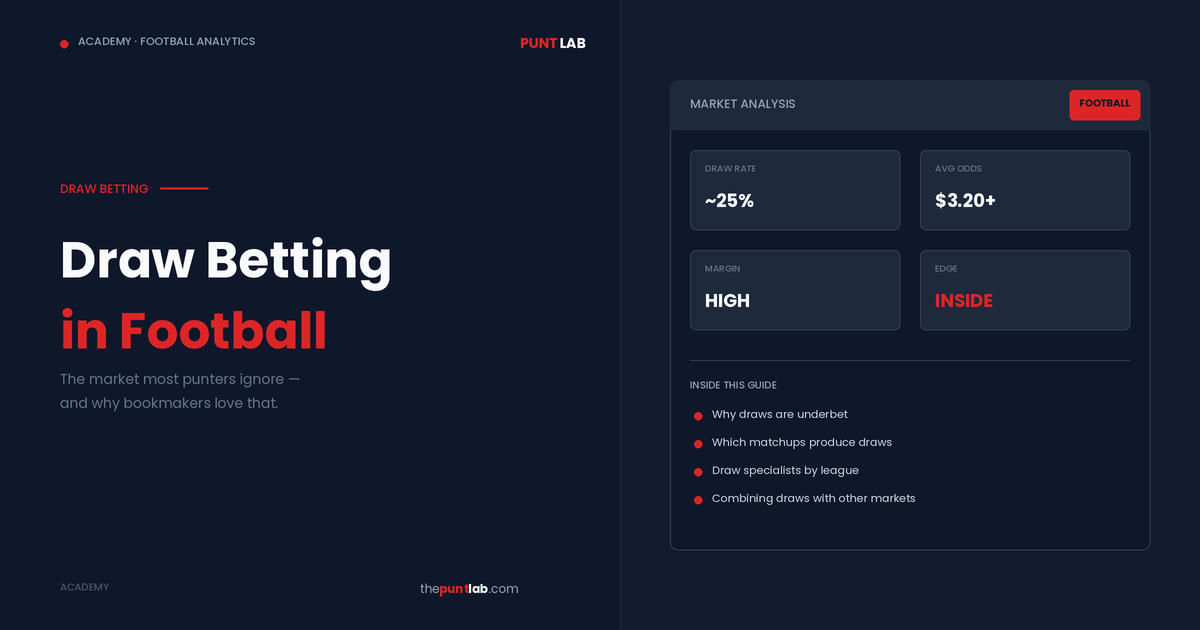
Roughly 25-27% of matches across Europe’s top five leagues end in draws. That’s more than one in four. Yet draws are the most underbet outcome in the match result market — recreational punters almost always back a team to win, and bookmakers love it because the draw carries some of the highest margins in 1X2 pricing.
This creates a structural edge. The draw is underbet, overpriced in margin terms, and predictable in specific match contexts that the public consistently ignores. This guide breaks down when draws happen, which matchups produce them, and how to exploit the market’s blind spot.
Why Draws Are Underbet
Punters want a winner. Psychologically, backing a draw feels like you’re not really picking a side — and humans are wired to pick sides. The result is that draw money makes up roughly 15-20% of total market volume despite draws occurring 25-27% of the time.
Bookmakers profit from this imbalance. They can set wider margins on the draw because fewer sharp bettors focus on it. The vig on the draw outcome is typically 1-2 percentage points higher than on the home or away win in the same market.
Despite this, draws remain viable because the base rate is high enough that even with wider margins, specific matchup conditions produce draws at frequencies that exceed the implied probability of the odds.
What Drives Draws
1. Evenly Matched Teams
The most obvious driver. When two teams of similar quality meet, the probability of a draw increases because neither side is significantly more likely to win. Matches between teams ranked 6th and 9th in a league produce draws far more frequently than matches between 1st and 18th.
How to use it: Check the H2H implied probabilities after stripping the vig. If the home win and away win are both in the 35-45% range, the draw probability should be 20-28%. If the bookmaker’s implied draw probability (after vig removal) is below this range, the draw may offer value.
2. Low-Scoring Expected Matchups
Draws are strongly correlated with low-scoring games. If both teams are expected to score fewer than 1.2 goals each, the most common scorelines are 0-0, 1-0, 0-1, and 1-1 — two of which are draws. The lower the expected total goals, the higher the draw probability.
How to use it: Cross-reference with xG data and Over/Under analysis. Matches where both teams have low xG output and low xGA are prime draw candidates. If the total is set below 2.5 goals and the Under is favoured, the draw is structurally more likely.
3. Defensive Team Involvement
Teams built around defensive solidity — low block, compact shape, minimal risk-taking — produce draws at elevated rates. When one or both teams prioritise not losing over trying to win, the natural outcome trends toward stalemate.
League examples: In La Liga, Getafe and Atletico Madrid historically produce above-average draw rates because their defensive structures suppress goals. In Serie A, teams managed by defensively-minded coaches consistently draw more than the league average.
4. Specific Match Contexts
Dead rubbers: End-of-season matches where both teams have nothing to play for produce elevated draw rates. Neither side is motivated to take the risks required to win, resulting in passive, low-intensity games.
Derby matches: Counterintuitively, many derbies produce draws at above-average rates because the intensity and caution cancel each other out. Teams that might normally play attacking football become conservative against their rival to avoid the humiliation of a loss.
Away team protecting a lead: In two-legged cup ties, the team leading on aggregate away from home often plays conservatively. This doesn’t apply to single-match betting directly, but the principle — motivation shapes tactics which shapes results — is universal.
Draw Rates by League
Draw frequency varies significantly between leagues due to tactical culture and competitive balance:
La Liga: Historically the highest draw rate among top-5 leagues — around 26-28%. The tactical, possession-based style produces patient, lower-scoring games.
Serie A: Also elevated — around 25-27%. Italian football’s defensive heritage still influences match outcomes.
Ligue 1: Moderate — around 24-26%. The PSG dominance means many matches are mismatches, reducing draw frequency in their games.
Bundesliga: Lowest among top-5 leagues — around 22-24%. The attacking, high-pressing German style produces more decisive results.
Premier League: Moderate — around 24-26%. High competitiveness throughout the table means many close games, but the aggressive tempo also produces more goals that break deadlocks.
The Draw and Asian Handicap
Asian Handicap betting eliminates the draw as a possible outcome, which is why many sharp bettors prefer it. But this creates an opportunity in the 1X2 market: if sharp money moves into Asian Handicaps because they offer better structure, the 1X2 draw can be left underpriced.
How to exploit this: Compare the implied draw probability from the 1X2 market with the AH 0 (draw no bet) pricing. If the 1X2 draw is priced at $3.40 (29.4% implied) but the AH 0 pricing implies a 32% draw chance, the 1X2 draw may offer value.
Combining Draws With Other Markets
Draw + Under 2.5: When you expect a draw, it’s usually a low-scoring draw. Combining the draw with Under 2.5 goals as separate bets (not a multi) gives you two correlated value opportunities. If your analysis says the draw is likely, the Under is also likely because draws are overwhelmingly low-scoring.
Half-time draw: Roughly 40% of matches are level at half-time, but the HT draw is often priced at $2.00-$2.20 (implying 45-50%), which means it’s close to fair. The edge here is smaller but the variance is lower because you’re only predicting 45 minutes, not 90.
Correct score 1-1: The most common draw scoreline. If you have a strong view that a match will be drawn, the correct score 1-1 typically offers $6.00-$8.00. The margin is high (this is an exotic market), but if your model gives the 1-1 a 15%+ chance, the odds may still represent value.
A Practical Framework
Step 1: Identify matches between evenly-matched teams (implied win probabilities within 10 percentage points of each other).
Step 2: Check whether the expected total goals are low (both teams’ xG below 1.3, or the total line at/below 2.5).
Step 3: Check for contextual factors — dead rubber, derby, defensive team involved.
Step 4: Strip the vig from the 1X2 market and check whether the draw is priced below your estimated probability.
Step 5: If the draw offers value, consider supporting it with an Under 2.5 bet if the totals market also looks underpriced.
The Bottom Line
Draws are the forgotten market. The public ignores them, bookmakers overcharge for them, and yet they occur in more than a quarter of all matches. If you’re willing to back outcomes that don’t feel exciting — the 0-0, the 1-1, the tactical stalemate — the draw market offers some of the most consistent structural value in football betting.
Related Reading
- xG Explained — Expected goals for draw prediction
- Over/Under 2.5 Goals — The correlated market
- BTTS Explained — Both Teams to Score
- Asian Handicap Explained — The market that removes draws
- Home Advantage — Does home team = fewer draws?
- Market Percentages (The Vig) — What you’re paying on draws
Tools
Vig Remover Strip 1X2 margin to find true draw probability Odds Converter Convert draw odds to implied probability Kelly Calculator Stake draw bets to your edge Betting Tracker Track draw bets separately