If Part 1 was about reading the map, Part 2 is about building one. This is where speed maps stop being a visual guide and start becoming a mathematical model.
Every serious speed map is a probability exercise. It’s not just “Horse A is fast.” It’s: what’s the probability Horse A leads given the speed figures of every other runner in the field? That requires data, statistics, and — increasingly — algorithms.
Velocity: The Core Metric
Velocity is distance divided by time, measured in metres per second (m/s). Simple concept, powerful application.
If a horse covers 400 metres in 25 seconds, its velocity is 16 m/s. Another horse doing 400 metres in 28.6 seconds runs at 14 m/s. After that first 400 metres, Horse A is several lengths clear — and the race has barely started.
The formula:
Velocity (v) = Distance (d) ÷ Time (t)
Example: 400m ÷ 25s = 16 m/s
This matters because velocity isn’t constant. Most horses run their fastest in the first 200-400 metres, then decelerate. Closers do the opposite — they conserve early and accelerate late. Knowing each horse’s velocity curve at different race stages tells you exactly where they’ll be positioned.
Factors That Shift Velocity
Starting burst. Some horses jump and run. They hit peak velocity in the first 200 metres then gradually fade. These are your natural leaders.
Stamina profile. Others start 1-2 m/s slower but maintain their speed deep into the race. Over 1600m+, these horses catch and pass the early speedsters.
Track conditions. A wet track can drop velocity by 5-10%. A horse running 16 m/s on firm ground might only manage 14.4 m/s on a Heavy 8. That changes every position prediction in the map.
Jockey instructions. A jockey told to “take a sit” might deliberately reduce their horse’s early velocity by 1-2 m/s, even if the horse wants to lead. This is the hardest variable to model — and often the one that wrecks a speed map entirely.
How Algorithms Build Speed Maps
Modern speed maps aren’t drawn on napkins. They’re generated by algorithms processing thousands of data points per field.
What the Algorithm Considers
Historical speed data — how fast has this horse run over similar distances in its last 5-10 starts?
Sectional times — what’s its typical velocity at the 400m, 800m, and 1200m marks? This is more valuable than overall race time because it reveals the horse’s speed profile at each stage.
Recent trend — is the horse improving or declining? A horse whose sectionals are getting faster each start is a different prospect than one gradually slowing down.
Track condition adjustment — the algorithm applies a percentage modifier based on how the horse has historically performed on today’s surface rating.
Competitor interaction — this is the clever part. The algorithm doesn’t just model each horse in isolation. It models how they interact. If Horse A and Horse C are both natural leaders drawn next to each other, the algorithm predicts a speed battle — increasing early velocity for both, but also increasing their deceleration later in the race.
A Worked Example
Say the algorithm has three horses in a 1200m race:
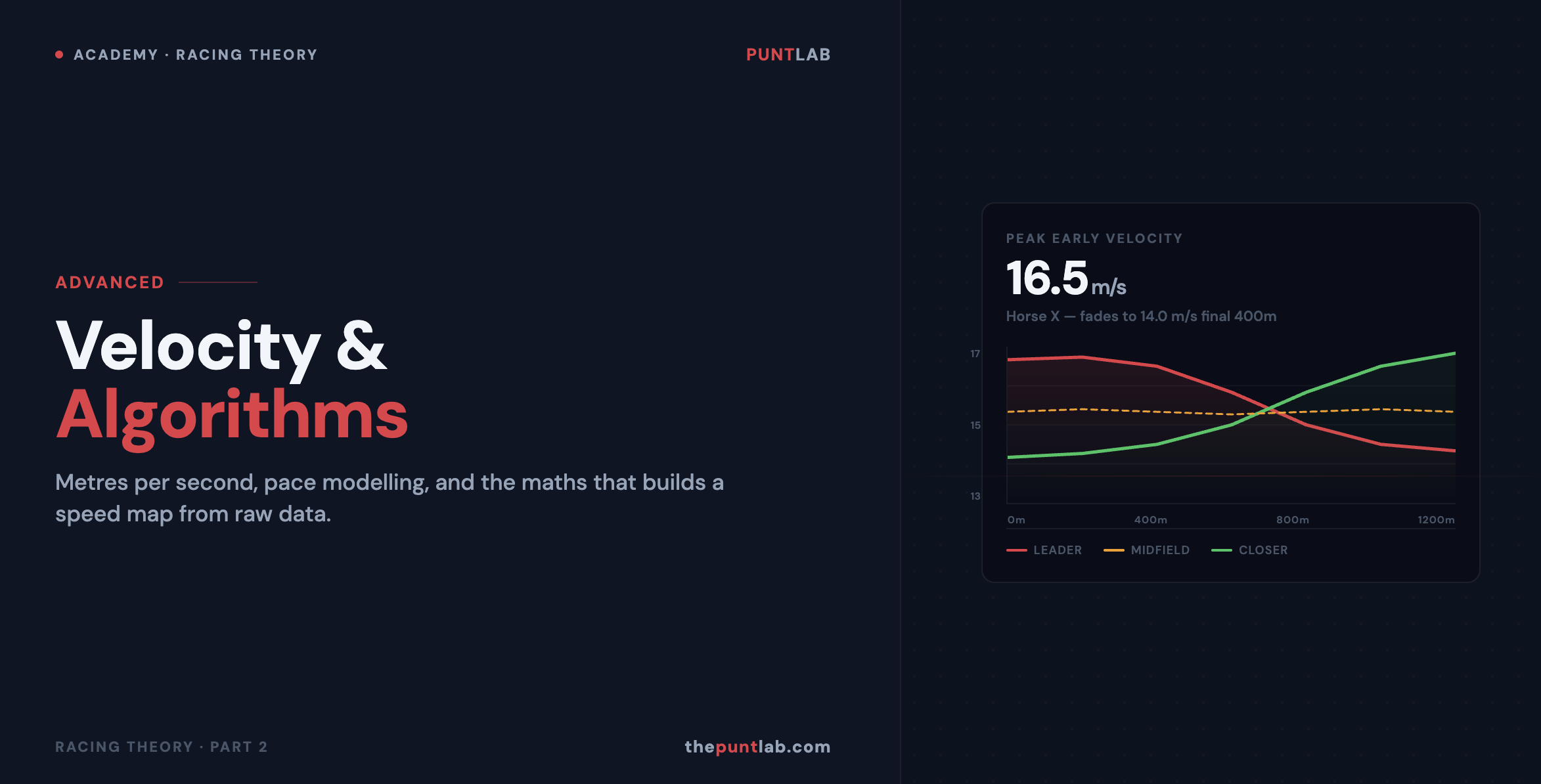
Horse X — average early velocity 16.5 m/s, fades to 14 m/s in the final 400m. Natural leader.
Horse Y — consistent 15 m/s throughout. Sits midfield, rarely wins but always runs on.
Horse Z — starts at 14 m/s, accelerates to 17 m/s in the final 400m. Classic closer.
On a dry track with no speed pressure, Horse X leads comfortably, Horse Y sits 2-3 lengths back, Horse Z trails by 5+ lengths. Horse X wins — it was never challenged and had enough left in the tank.
Now add a second leader to the field. Suddenly Horse X is pushed to 17 m/s early, burns energy, and fades to 13 m/s in the run home. Horse Z’s closing burst now runs right over the top. Same horses, completely different result — and the speed map predicted it.
Applying Adjustments
The real power is in layered adjustments. Say track conditions are soft, reducing velocity by 10%:
Base velocity: 16 m/s
Track adjustment (−10%): 16 × 0.9 = 14.4 m/s
Distance covered in 25 seconds:
14.4 × 25 = 360m (not 400m)
That 40-metre difference at the first mark ripples through the entire race. Every position shifts. The algorithm recalculates the map with these adjusted velocities and produces a completely different picture than the dry-track version.
Turning This Into an Edge
All of this is interesting, but the question is: how does it make you money?
Spot the Pace Collapse
When your speed map shows three or four natural leaders drawn close together, the early pace will be suicidal. Look for the backmarker with a proven closing burst. The market often underrates closers in these scenarios because punters fixate on “class” and “form” without considering race dynamics.
Back the Lone Leader
A single leader in a field of closers is dangerous at any price. With no pressure up front, it dictates the tempo, conserves energy, and kicks clear in the straight. The market sometimes lets these horses drift because they’re not the “best” horse in the field on raw ratings — but the speed map says they’ll get the dream run.
Fade the Wide Draw
On tight tracks, a midfield runner drawn wide is covering extra ground every time the field turns. The speed map might show it settling fourth — but fourth from barrier 12 means fourth and three-wide. That’s a losing position. The market rarely accounts for this properly.
Cross-Reference with Your Betting Calculators
Once you’ve identified your edge through the speed map, run the numbers. Use the Kelly Criterion calculator to size your bet based on your estimated probability vs the market price. If the speed map gives a closer a 30% chance of winning but the market has it at $5.00 (20% implied), you’ve found genuine value.
Explore more betting theory and tools in the Betting Academy →