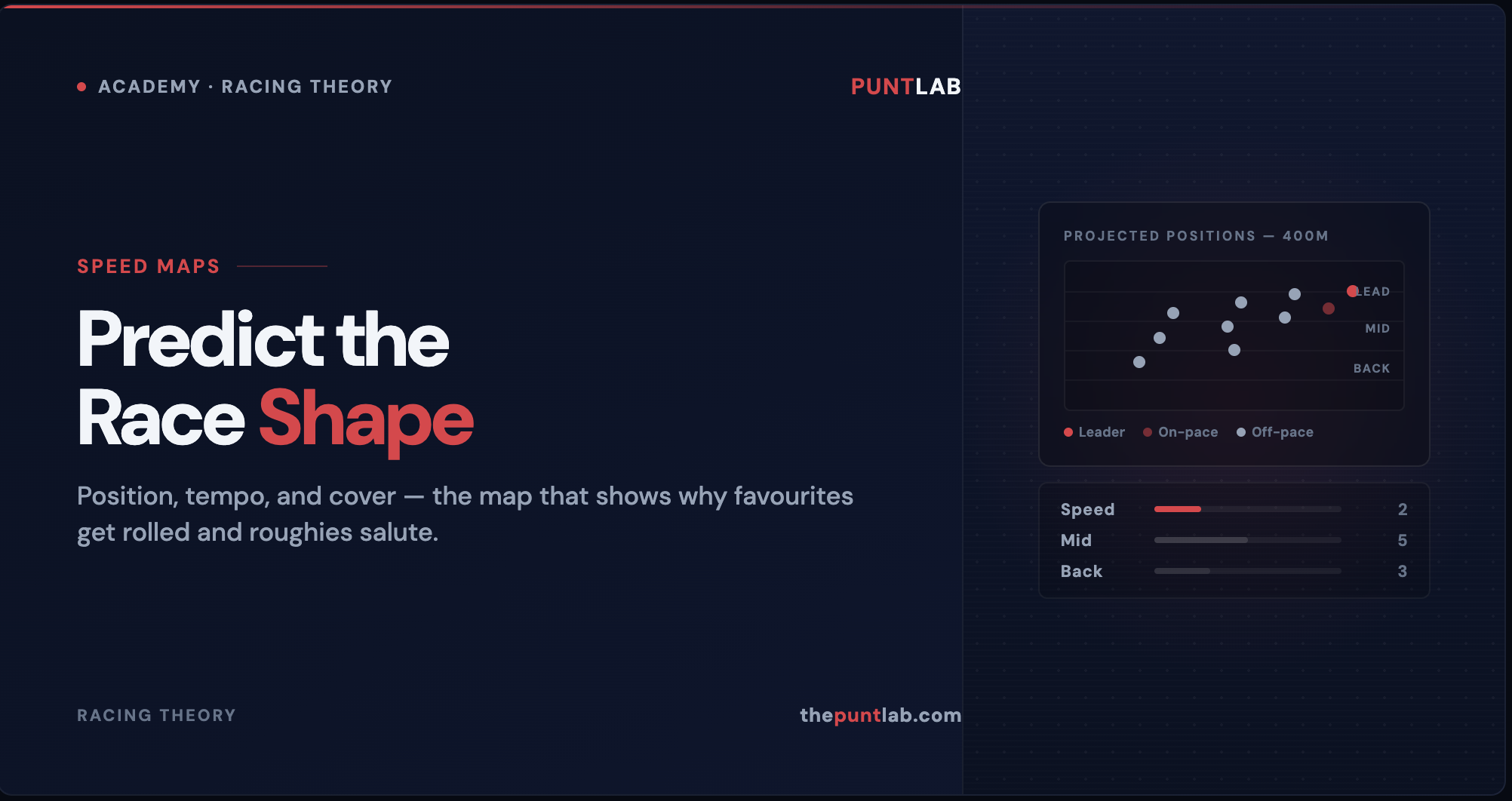
In Australian racing, the best horse doesn’t always win — because races aren’t run in a vacuum. They’re won and lost through position, tempo, and how much petrol a horse burns before the 600m.
A runner that finds the right spot and gets a soft run can beat a better horse that’s posted wide, trapped without cover, or forced to chase a brutal early pace. You see it every Saturday: the favourite gets rolled, everyone blames the jockey… but the real damage happened in the first 200 metres.
That’s what speed maps are built for — predicting the likely running pattern of a race so you can understand why certain horses get dream runs while others need luck, breaks, and a prayer.
What a Speed Map Actually Tells You
A speed map is a pre-race projection of where each runner will settle in roughly the first 300–500 metres (think: “who leads, who sits outside the leader, who gets cover, who gets posted”). It’s not magic — it’s a structured guess based on repeatable inputs:
- Beginning speed / early position in running
- Barrier draw
- Rider intent / stable patterns
- What the rest of the field is likely to do
You’ll hear the basic labels — leader, on-pace, midfield, backmarker. The edge isn’t knowing the label. The edge is knowing what the label means in this field, from this gate, on this track, at this distance.
Example: a natural leader drawn 1 in a race with no other speed is completely different to that same horse drawn 12 with two other push-forward types inside it. Same “leader.” Totally different race.
If you want to get better at race shape analysis, this is where it starts.
The 3 Questions That Make Speed Maps Profitable
Forget fancy jargon. Most profitable speed map reads come down to three questions:
1) Who controls the tempo?
If there’s a lone leader, they can pinch cheap sectionals, stack the field, and kick. That’s why “soft lead” horses can look like champions one week and pumpkins the next.
If there’s pressure (two or three that genuinely want the front), the tempo lifts, fuel gets burned early, and suddenly the race sets up for something sitting off them with cover.
2) Who gets the soft run?
This is the “hidden class” of racing. A horse that maps one-one (outside leader with cover) or leaders back on the fence often runs 1–2 lengths better than its raw ability. It’s not improvement — it’s efficiency.
This is also where barrier draws matter most:
- Inside draws = easier to hold ground and get cover
- Wide draws = decisions, and decisions cost energy
3) Who is likely to do the hard work?
This is the killer — and it’s where favourites die.
If a horse maps to be:
- three-wide with no cover, or
- forced to work early to cross, then still sit exposed,
…it doesn’t need to be a bad horse to lose. It just needs to spend petrol at the wrong time.
If you’re wondering why a $2.50 pop ran fourth without ever looking like winning, check the map. Good chance it did its work before the 600m.
The Most Common “Map Bias” Scenarios
Speed maps aren’t just about “where they sit.” They’re about structural advantage — the race shape that helps one run style and kills another.
Lone leader bias: One genuine speed horse controls the tempo and becomes harder to run down than the market prices.
Speed battle bias: Contested lead = fast early pace = leaders vulnerable = runners with cover and a turn of foot come into it.
Wide/no-cover bias: A horse drawn awkward with moderate speed gets caught in the worst spot in racing. This is one of the most reliable “lay signals” you’ll find.
And it’s deadly when it applies to a favourite: the market often prices the horse, not the shape.
How to Use Speed Maps on Race Day Without Overthinking It
- Do your first map the night before (barriers + typical patterns).
- Re-check after scratchings — one late scratching can turn a speed battle into a soft lead.
- Match it with track pattern:
- If the track is playing on-pace, a soft lead becomes gold.
- If leaders are getting swallowed, a speed battle makes closers live.
You don’t need software. You need clarity.
Speed maps won’t replace form — they explain it. Form tells you what happened. A speed map tells you why, and whether it’s likely to happen again.
FAQ
What is a speed map in horse racing?
A speed map is a pre-race prediction of where runners will settle early, which helps you read tempo and race shape.
Why do speed maps matter for betting?
Because position and tempo decide which horses get soft runs and which are forced to do extra work — that’s often the difference between value and a bad bet.
What is “three-wide no cover”?
It means a horse sits wide without another horse shielding it from the wind. It usually burns extra energy and is a common reason favourites get beaten