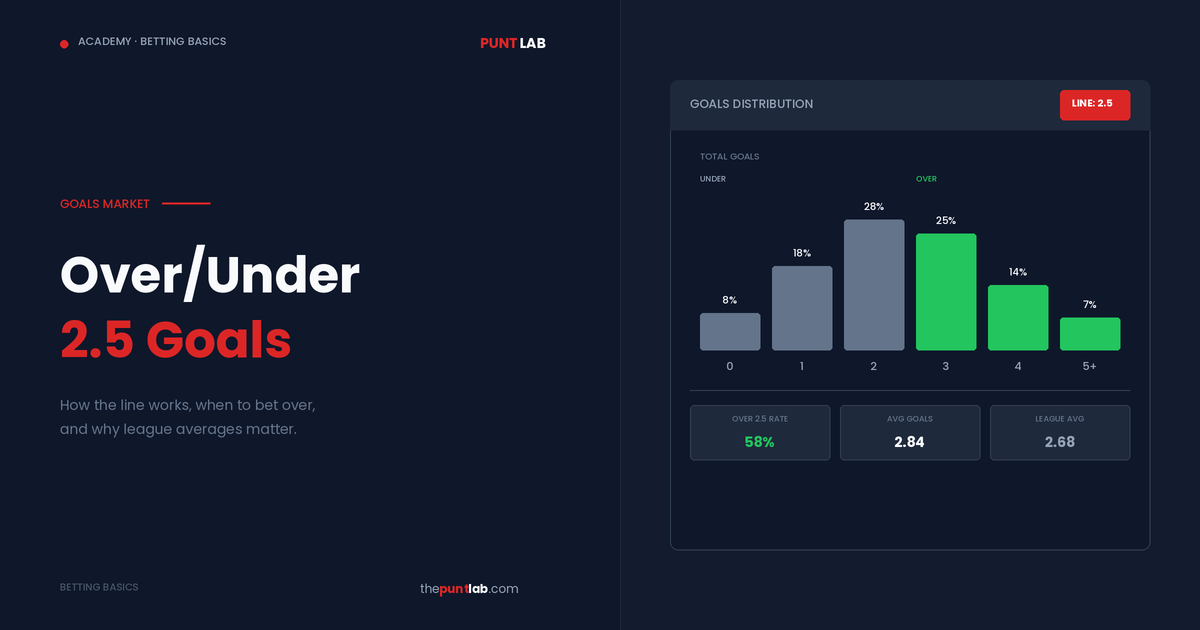
The Over/Under 2.5 Goals market is the second most popular football betting market after match result — and in some leagues, it’s the most popular. It’s also one of the most data-friendly markets in existence, which makes it a natural fit for punters who prefer numbers over narratives.
The concept is simple, but betting it profitably requires understanding what drives goal totals, how bookmakers set the line, and why league context changes everything.
How Over/Under 2.5 Goals Works
The bookmaker sets a goal line — almost always 2.5 in standard markets — and you bet on whether the total goals scored by both teams will be over or under that number.
Over 2.5 wins if there are 3 or more goals in the match. It doesn’t matter who scores them — a 3-0 win, a 2-1 result, or a 4-3 thriller all settle as Over 2.5.
Under 2.5 wins if there are 0, 1, or 2 goals total. A 0-0 draw, a 1-0 win, or a 1-1 draw all settle as Under 2.5.
The .5 in the line eliminates draws — there’s no “push” or refund. Every match settles one way or the other, which is part of the market’s appeal.
Why 2.5 Is the Standard Line
The 2.5 line exists because it sits close to the average number of goals in most professional football leagues. Across the top five European leagues over the past decade, the average goals per match typically falls between 2.5 and 2.9. That puts the 2.5 line right at the tipping point where roughly 50-55% of matches go Over and 45-50% go Under.
This near-50/50 split is exactly what bookmakers want. It creates balanced action on both sides, which means they profit from the margin regardless of the outcome. When one side of a market attracts significantly more money than the other, the bookmaker is exposed — the 2.5 line minimises that risk.
Other lines exist — you’ll see Over/Under 1.5, 3.5, and even Asian goal lines like 2.25 or 2.75 — but 2.5 is the benchmark. If you understand how to bet 2.5, the principles apply to every other line.
How Bookmakers Price the Goals Line
Goals markets are priced using a combination of team-level scoring data, expected goals (xG) models, and league-wide averages. The process works like this:
The bookmaker estimates the expected goals for each team. If they project Arsenal to score 1.8 goals and Chelsea to score 1.1 goals, the expected total for the match is 2.9. A Poisson distribution model then converts that 2.9 expected total into probabilities for every possible scoreline — 0-0, 1-0, 1-1, 2-1, and so on. Summing the probabilities of all scorelines with 3+ total goals gives the true Over 2.5 probability.
The bookmaker then applies their margin — the vig — to convert that probability into odds. If the model says Over 2.5 has a 58% chance, fair odds would be 1.72. After margin, you might see 1.65. The gap between the fair price and the offered price is where the bookmaker makes money.
Understanding this process matters because it tells you where the edge can appear: when the bookmaker’s inputs (team xG, league averages, recent form) lag behind reality. A team that’s just lost its starting striker will see its xG drop — but the bookmaker might be slow to fully adjust the line.
What Drives Goal Totals
1. Expected Goals (xG) — The Best Predictor
If you only look at one stat, make it xG. Expected goals measures the quality of chances created, stripping out the noise of finishing variance. A team might score 0 goals from 2.0 xG one week and 3 goals from 0.8 xG the next — but over time, actual goals converge toward xG.
For Over/Under betting, you want both teams’ xG numbers. Add Team A’s xG For to Team B’s xG For (or equivalently, Team A’s xG For plus Team A’s xG Against from the opponent’s perspective) to get an expected total. If that total is significantly above or below 2.5, you’ve got a starting point.
Our guide on How to Use xG to Find Value Winners covers expected goals in detail.
2. League-Wide Scoring Averages
Not all leagues are created equal. This is one of the most important — and most overlooked — factors in goals betting.
The Bundesliga consistently averages the highest goals per match among Europe’s top five leagues, often sitting around 3.0-3.2 per game. The Premier League typically falls in the 2.7-2.9 range. Serie A and Ligue 1 tend to be lower, often around 2.5-2.7.
These differences might sound small, but they compound significantly when you’re pricing bets. In a league averaging 3.1 goals per match, Over 2.5 hits in roughly 60% of matches. In a league averaging 2.5, it hits around 48-50%. If the bookmaker prices both at the same implied probability, one of them is wrong.
You can check the current Over 2.5 percentages for every team across the Premier League, La Liga, Serie A, Bundesliga, and Ligue 1 on our Data Hub pages.
3. Home vs Away Splits
Teams play differently at home and away, and this shows up clearly in goal totals. Home teams generally score more and concede less. This means a team’s Over 2.5 rate at home can be significantly different from their away rate.
Always check the home/away split rather than the overall number. A team might have a 55% Over 2.5 rate overall, but that could break down as 65% at home and 40% away. If you’re backing Over 2.5 in their away match based on the overall figure, you’re using the wrong number.
4. Head-to-Head History
Some fixtures consistently produce goals. Derby matches, top-four clashes, and games between two attack-minded sides often have historical Over 2.5 rates well above the league average. This isn’t superstition — it reflects tactical matchups, open play styles, and psychological factors that repeat.
That said, don’t overweight H2H data from years ago. Squads change, managers change, and a fixture that produced 4+ goals two seasons ago might be a 1-0 grind under different circumstances. Weight the last 2-3 seasons more heavily than older data.
5. Match Context and Motivation
Context matters more for goals markets than almost any other bet type. A dead rubber between two mid-table sides with nothing to play for often produces open, carefree football — and goals. A relegation six-pointer between two defensive sides terrified of losing produces the opposite.
End-of-season matches, final matchday fixtures, and games where one side has already secured their objective (qualified for Europe, avoided relegation) tend to see different goal patterns than high-stakes matches where the margin for error is thin.
Common Over/Under Mistakes
Recency Bias
A team’s last three matches going Over 2.5 doesn’t mean the next one will. If their xG data suggests those were outliers — lucky finishes, defensive errors, or unusual circumstances — the market has probably already adjusted, and you’re betting on noise rather than signal. Always check whether the recent goal totals are supported by the underlying chance creation data.
Ignoring the Other Team
Over/Under is a match bet, not a team bet. A high-scoring attack facing an elite defence might produce fewer goals than two average sides who both leave space at the back. Always assess both teams’ profiles together, not individually.
Assuming Over Is the “Fun” Bet
Recreational punters overwhelmingly back Over rather than Under. This is well documented — the appeal of cheering for goals creates a systematic bias toward Over bets. Bookmakers know this and often shade their odds accordingly, making Under slightly better value on average. This doesn’t mean you should blindly back Under — it means you should recognise that the Over price often includes a “fun tax” that reduces your edge.
Not Adjusting for Missing Players
Injuries and suspensions to key attacking or defensive players can shift a match’s expected goal total by 0.3-0.5 goals. That’s a massive swing in a market where the line sits right at the average. A team without its top scorer and creative midfielder is a fundamentally different proposition than the same team at full strength.
Over/Under 2.5 vs BTTS
These two markets are cousins, not twins. They’re correlated — high-scoring matches tend to see both teams score — but they diverge more often than most punters expect.
A 3-0 result is Over 2.5 but BTTS No. A 1-1 result is BTTS Yes but Under 2.5. The markets ask different questions: Over/Under asks “how many goals total?” while BTTS asks “will both sides score?”
The practical implication is that you should pick the right market for the specific matchup. If you expect a dominant team to score freely against a weak opponent that won’t score at all, Over 2.5 is the sharper bet. If you expect a tight, competitive match where both sides will create chances but the total might stay at 2, BTTS Yes might be the better angle.
Alternative Goal Lines
Over/Under 1.5 Goals
A much lower bar — you’re simply betting that there’ll be at least 2 goals. Over 1.5 hits in around 70-75% of matches across major leagues, which means the odds are short (usually 1.20-1.35). The value, when it exists, is almost always on Under 1.5 at longer odds in specific low-scoring matchups.
Over/Under 3.5 Goals
A higher threshold — you need 4+ goals for Over to win. This hits in roughly 30-40% of matches depending on the league. The odds are longer (typically 1.80-2.20 for Over), but the variance is higher. This line rewards punters who can identify genuinely high-scoring fixtures rather than just “above average” ones.
Asian Goal Lines (2.25, 2.75)
Asian lines split your stake across two adjacent lines. Betting Over 2.25 means half your stake goes on Over 2.0 and half on Over 2.5. If there are exactly 2 goals, you lose half (the Over 2.5 portion) and push on the other half (Over 2.0). These lines offer finer precision and are favoured by professional bettors who want to reduce variance.
If you want to understand Asian line mechanics in detail, our Asian Handicap guide explains the split-stake concept.
Using PuntLab’s Data for Goals Betting
Every league page on PuntLab includes the stats you need for Over/Under analysis. Here’s the workflow:
Step 1: Check both teams’ Over 2.5% on the relevant Data Hub page (Premier League, La Liga, Bundesliga, Serie A, Ligue 1). Look at home/away splits, not just the overall number.
Step 2: Cross-reference with the BTTS percentage. If both Over 2.5% and BTTS% are high, you’re looking at two teams that concede and score regularly — a strong Over 2.5 candidate.
Step 3: Read the match preview for team news, injuries, and recent form context. A team missing key attackers changes the equation entirely.
Step 4: Compare odds across bookmakers using our odds tables. Even a 0.05 difference in odds compounds significantly over hundreds of bets.
Step 5: Calculate implied probability using our Odds Converter. If the odds imply 54% for Over 2.5 but your analysis suggests 60%, you have an edge. If they’re close, pass.
The Bottom Line
Over/Under 2.5 is one of the most quantifiable markets in football betting. Goals are driven by measurable factors — xG, league averages, home/away splits, team profiles — and the data to assess these factors is freely available on every league page of this site.
The edge comes from doing the work the market hasn’t done yet: checking the latest team news, adjusting for context, and comparing your probability estimate to the implied probability of the odds. When the gap is real, bet it. When it’s not, wait.
Most punters bet goals on feel. The ones who profit bet them on data.
Related Reading
- What Is BTTS? Both Teams to Score Explained — The cousin market to Over/Under
- How to Use xG to Find Value Winners — The stat that underpins goals analysis
- Market Percentages (The Vig) — How bookmakers build their margin into every price
- Asian Handicap Explained — Split-stake mechanics for finer precision
Tools
- Odds Converter — Convert between decimal, fractional, and American odds
- Vig Remover Calculator — Strip the bookmaker’s margin from any price
- Kelly Criterion Calculator — Optimal staking when you’ve identified an edge