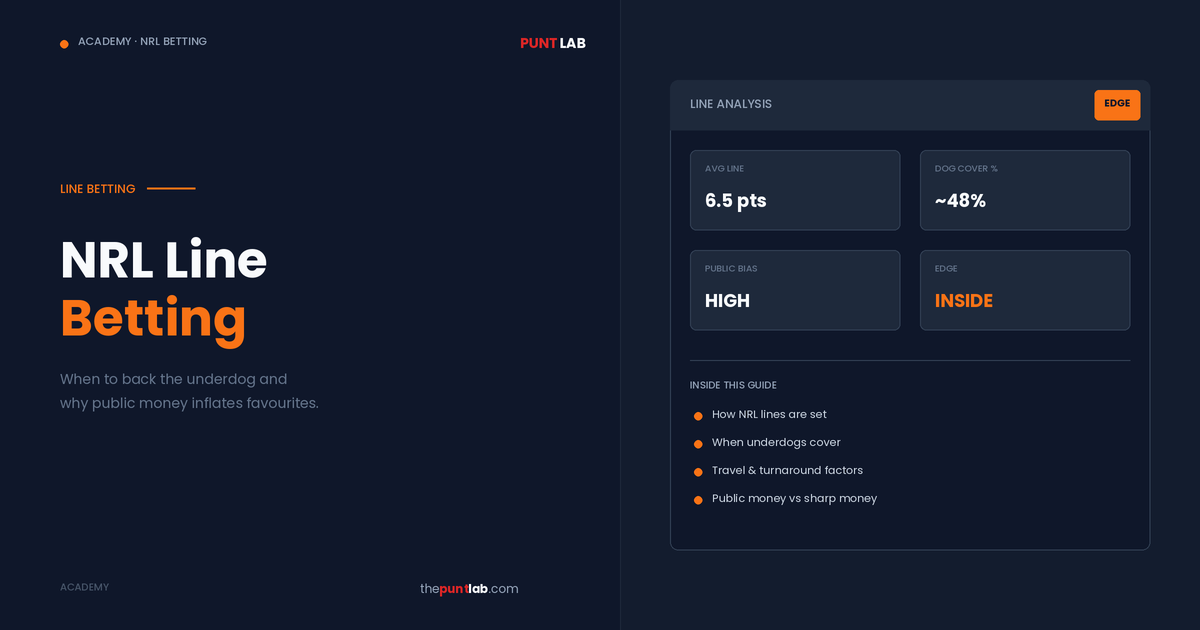
Line betting is where the smart money goes in NRL. The margins are tight, the market is liquid, and the data is clear enough to build genuine edges. But the public consistently makes the same mistakes — overvaluing popular teams, underestimating underdogs, and ignoring situational factors that the line doesn’t always capture.
This guide breaks down how NRL lines are set, when underdogs cover, and where the market gets it wrong.
How NRL Lines Are Set
Bookmakers build NRL lines using a power rating system — each team has a numerical strength rating that gets adjusted for home ground advantage, recent form, and available players. The difference between two teams’ ratings, plus a home advantage adjustment (typically 3-4 points), produces the expected margin. That margin becomes the line.
For example, if the Roosters are rated at 72 and Souths at 64, the raw expected margin is 8 points. Add 3 points for Roosters home advantage and you get a line around Roosters -11.5.
But that’s just the opening line. Once betting opens, the line moves based on where money flows. If the public hammers the Roosters, the line shifts from -11.5 to -12.5 or -13.5. The bookmaker isn’t necessarily changing their assessment — they’re managing liability. And when the line moves beyond what the data supports, value appears on the other side.
Why Underdogs Cover More Often Than You Think
Across NRL history, underdogs on the line cover at roughly 48-50% — essentially a coin flip. But the public bets as if favourites cover far more often, which is why the bookmaker can maintain a margin on both sides.
The reason is psychological. Backing a team at -8.5 feels safe when they’ve been winning by 20 points. Backing the opponent at +8.5 feels like throwing money away. But the data doesn’t care about feelings. Several specific situations consistently produce underdog covers:
1. Short Turnarounds
NRL teams playing on less than 6 days’ rest show a measurable decline in performance — lower completion rates, more missed tackles, and reduced running metres. When a favourite is on a short turnaround and the underdog has had a full week’s preparation, the line often doesn’t fully adjust.
This effect is amplified when the favourite’s short turnaround follows a physically demanding match (a tight, contested game rather than a blowout where starters were rested early).
2. Travel
Interstate travel affects NRL performance. Teams travelling from Sydney to Brisbane face minimal disruption. Teams travelling to New Zealand, Perth (when applicable), or far north Queensland face genuine fatigue and scheduling challenges.
The market prices travel to some degree, but the effect is inconsistent — it depends on the travel distance, the departure/arrival timing, and whether the team travelled immediately after a match or had rest days. When travel compounds with a short turnaround, the impact on the favourite’s margin is significant.
3. Rivalry and Derby Matches
Derbies — Roosters vs Rabbitohs, Manly vs Parramatta, Brisbane vs Gold Coast — consistently produce tighter results than the H2H odds suggest. The motivation gap between a dominant team and a struggling rival narrows in derby matches because pride, crowd intensity, and familiarity compress the performance difference.
If a team is heavily favoured in a derby, the line may reflect their season-long superiority rather than the derby-specific dynamic. Underdog covers are disproportionately common in these fixtures.
4. Nothing-to-Lose Situations
Teams eliminated from finals contention or with nothing to play for occasionally produce terrible results. But the opposite also happens — freed from pressure, some sides play with freedom and aggression that makes them dangerous opponents.
The more reliable edge is on the other side: teams with everything to play for — fighting for a top-four spot, desperate to avoid the wooden spoon, playing for a departing coach or retiring player — consistently outperform their rating in must-win situations. The emotional factor is real and the line often underweights it.
When Favourites Cover
It’s not all about underdogs. There are situations where the favourite’s line is generous:
Returning from a bye: NRL teams coming off a bye week are fresher, better prepared, and have had time to address specific weaknesses. Favourites returning from byes cover at an elevated rate compared to non-bye weeks.
Home team after an embarrassing loss: The “bounce-back” effect is real in NRL. Teams that suffered a heavy defeat the previous week frequently respond with a strong performance — particularly at home, where the crowd provides additional motivation. If the line hasn’t expanded to account for the bounce-back, the favourite may offer value.
Dominant forward pack vs lightweight opposition: When a team with a significantly stronger forward pack faces a lightweight opponent, the advantage in the middle of the field compounds as the game wears on. Second-half dominance by the stronger pack produces inflated final margins that cover lines the public thought were too wide.
Key Stats for Line Assessment
Points differential per game: The most fundamental indicator of a team’s true quality. A team averaging +8.5 points per game should be roughly an 8-9 point favourite against an average team at a neutral venue.
Completion rate: Teams that complete their sets at 78%+ maintain possession and scoring pressure. Low-completion teams (below 73%) create unpredictable, scrappy games where underdogs thrive.
Missed tackles per game: A strong predictor of defensive vulnerability. Teams missing 30+ tackles per game are likely to concede easy metres and tries, compressing margins even when they win.
Home/away splits: Some NRL teams show dramatic performance differences between home and away. Always check the specific team’s home vs away points differential rather than using their overall season number.
Second-half scoring trends: Teams that fade in the second half (through fatigue, fitness, or bench depth issues) are vulnerable to line covers by underdogs who stay competitive and close the gap late.
A Practical Framework
Step 1: Calculate the expected margin using each team’s points for/against, adjusted for home advantage (+3-4 points to the home side).
Step 2: Check for situational factors — short turnaround, travel, derby, bye week, must-win scenario.
Step 3: Adjust your expected margin for these factors. Short turnaround compresses by 2-3 points. Travel compresses by 1-2 points. Derby compresses by 2-4 points. These adjustments stack.
Step 4: Compare your adjusted expected margin to the bookmaker’s line. If the line is 3+ points wider than your assessment, the underdog side offers value. If the line is 3+ points tighter, the favourite side offers value.
Step 5: Strip the vig and convert to implied probability to confirm you have genuine positive EV before placing the bet.
The Bottom Line
NRL line betting is the closest thing to an efficient market in Australian sport — but efficient doesn’t mean perfect. Short turnarounds, travel, derbies, and emotional situations create consistent, measurable deviations from what the line predicts. The punters who track these factors systematically find edges that the public, betting on reputation and recency, consistently misses.
Related Reading
- NRL Betting Markets Explained — Every market, how it works
- How to Read NRL Form — The stats that predict results
- Tryscorer Markets — Where the biggest pricing edge lives
- Asian Handicap Explained — The football equivalent
- Market Percentages (The Vig) — Strip the margin
- Expected Value (EV) — Only bet with positive EV
- The Professional Workflow — Process over picks
Tools
- Vig Remover — Strip the margin on NRL lines
- Odds Converter — Convert to implied probability
- Kelly Criterion Calculator — Optimal staking
- Free Betting Tracker — Track line bets vs H2H separately