What Is a Form Guide?
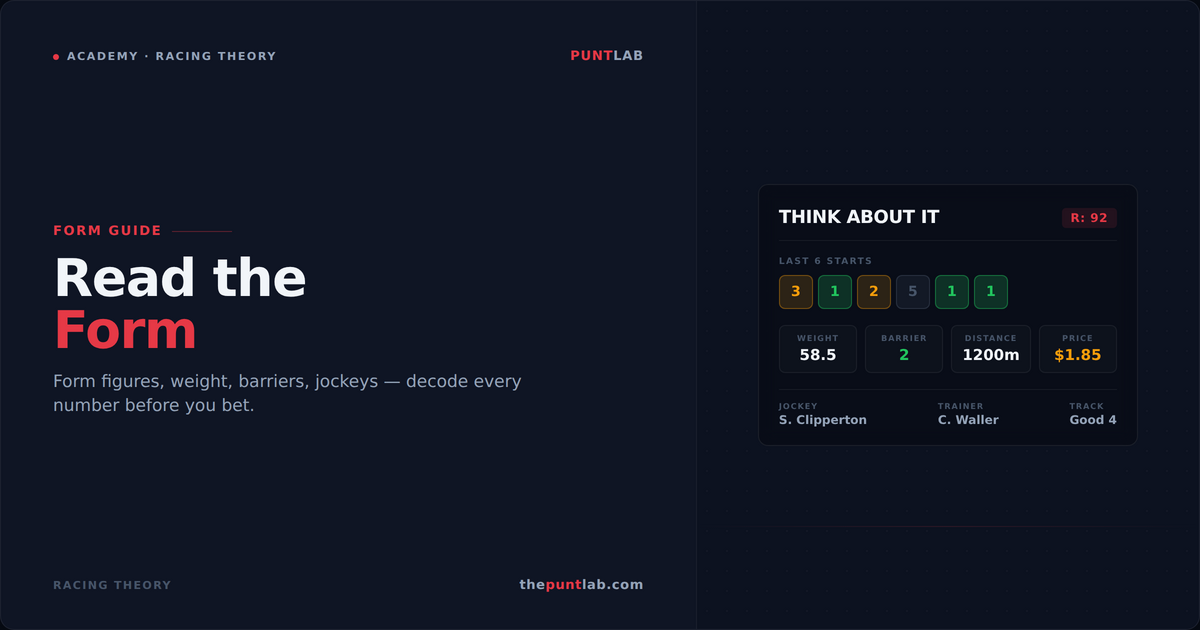
A form guide is a horse’s resume. It shows every recent run — where they finished, what weight they carried, which jockey was on board, the track conditions, barrier draw, and starting price. It’s the single most important tool for any racing punter.
Every horse in today’s race has a story told in numbers. Learning to read those numbers is what separates punters who guess from punters who analyse. Here’s how to read a form guide properly.
Breaking Down the Form Guide
Form Figures
The string of numbers next to a horse’s name is its recent finishing positions — most recent on the right. A “1” is a win, “2” is second, and “0” means the horse finished outside the top ten. An “F” means it fell. These figures give you a quick snapshot of consistency. A horse showing 2-1-3-1-2 is in strong form. A horse showing 0-7-0-5-8 is struggling.
Weight
This is the total weight the horse carries — jockey, saddle, and any handicap penalties. In handicap races, better-performed horses carry more weight to level the field. A horse dropping in weight from its last run is getting a better deal. A horse lumped with top weight after a win is being tested — the handicapper is asking whether it’s good enough to win under a heavier load.
Barrier Draw
The barrier is the starting gate number. Low numbers (1-4) are closest to the inside rail. High numbers are out wide. The importance of the barrier depends entirely on the track and distance. At some courses it barely matters. At others, it’s everything.
Take a 1000m sprint at Doomben — the start is almost on the bend. A horse drawn wide has to either use energy to cross early or cop extra ground on the turn. A horse drawn in barrier 1 saves lengths without trying. Over a short sprint, that’s the difference between winning and running third.
Smart punters check barrier stats for each track before betting. Most racing sites publish them, and the patterns are often stark — some tracks have a genuine inside bias, others favour the middle, and wet tracks can shift the advantage entirely.
Official Rating
Every horse gets an official rating based on its performances. These ratings determine how much weight a horse carries in handicap races — higher rating means more weight. They’re also useful for comparing horses across different races and classes. A horse rated 85 dropping into a race where the average is 70 has a clear edge on raw ability. The catch is it’ll carry more weight to compensate.
Jockey
The jockey matters more than most casual punters realise. In a close finish, the difference between winning and losing often comes down to the rider. Look for jockeys with strong strike rates at the specific track, not just overall stats. Some riders are brilliant at certain courses and average at others. Also watch for jockey changes — a leading rider picking up a new mount from a smaller stable is a quiet sign of confidence.
Trainer
The trainer prepares the horse’s fitness, diet, race plan, and overall campaign. A well-known trainer’s name next to a horse means it’s been professionally prepared, but don’t sleep on the smaller stables. Some of the best value comes from lesser-known trainers who target specific races with fit, ready horses that the market underestimates.
Why Barriers Matter More Than You Think
The barrier draw is one of the most underrated factors in racing. Here’s why it deserves serious attention.
Track layout — Every racecourse is different. Tracks with a sharp bend close to the start punish wide barriers. Tracks with long straights before the first turn reduce the barrier’s impact. Knowing the course layout tells you how much to weight the draw.
Ground conditions — After rain, the inside of the track often cuts up first because that’s where most horses run. On a heavy track, horses drawn wide might actually get better footing on fresher ground. This flips the usual bias completely.
Race tempo and traffic — Horses drawn in the middle can get squeezed between runners and stuck in traffic with nowhere to go. Horses drawn wide have clear air but cover more ground. Horses drawn inside risk getting boxed on the rail with no room to improve. The barrier doesn’t just affect the start — it shapes the entire race.
Track bias data — This is where serious punters get an edge. Most tracks develop statistical biases over time that you can look up. If barrier 1-3 wins 40% of races at a certain distance and course, that’s not luck — it’s track geometry. Use this data. You can learn more about how pace and position shape a race in our Speed Maps guide.
The Jockey-Trainer Partnership
Racing isn’t just about the horse. The people behind it matter enormously.
When a leading jockey regularly rides for the same trainer, they develop a shorthand — the trainer knows what the jockey needs to know, and the jockey understands the trainer’s methods. These partnerships produce results consistently because there’s trust and communication. When you see a proven jockey-trainer combination, it’s a positive signal.
What’s even more interesting is when a top jockey picks up a ride for a trainer they don’t usually work with. That often means the jockey has been specifically booked because the horse has a genuine chance. The jockey wouldn’t take the ride otherwise. These are the quiet confidence indicators that don’t show up in the odds until race day.
The best jockeys also adapt mid-race. If the pace is too fast, they settle. If there’s no speed, they roll forward. If the rail is off, they angle out. These split-second decisions are invisible to most viewers but they’re the reason the same jockeys keep winning.
Putting It All Together
Reading a form guide isn’t about finding one magic number. It’s about building a picture from multiple data points — recent form, weight, barrier, track conditions, jockey, trainer, and class. Each piece tells part of the story.
Start with form figures to gauge consistency. Check the weight to see if the horse is getting a fair deal. Look at the barrier relative to the track layout. Consider the jockey and trainer combination. Then ask yourself: does the price reflect all of this, or has the market missed something?
That last question is where betting value lives. The form guide gives you the information. What you do with it is what makes the difference. For the mathematical side of finding value, check out our Kelly Criterion guide and the Vig Remover calculator.