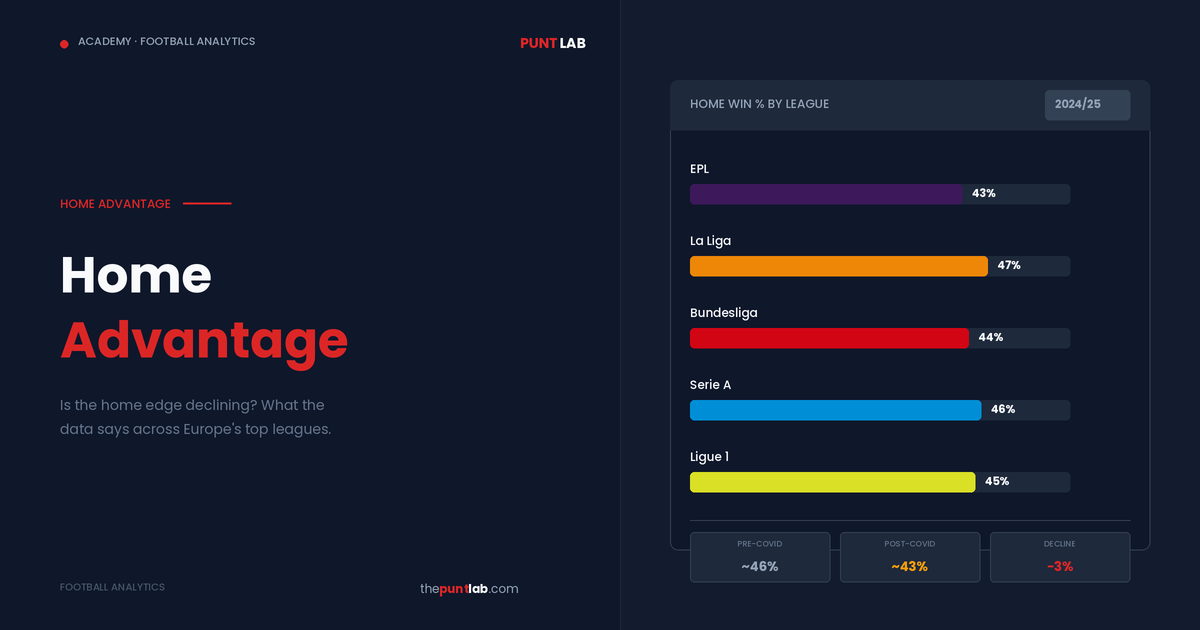
Home advantage is one of the oldest assumptions in sport. The home team wins more often — everyone knows that. But how much more often? Is it changing? And more importantly for punters: does the market already price it in, or is there an edge hiding in the data?
The answer is more nuanced than most people expect. Home advantage is real, measurable, and persistent — but it’s been declining for over a decade, and the reasons why have direct implications for how you bet on football.
What the Data Actually Shows
Across the top five European leagues, home teams historically won around 46% of matches, drew around 26%, and lost around 28%. That gives the home side a clear advantage — winning nearly half of all matches compared to just over a quarter for the away team.
But those are historical averages. The trend line tells a different story.
In the 2010s, home win rates in the Premier League sat consistently around 45-47%. Post-2020, that figure has dropped to roughly 41-44% in most seasons. The pattern is similar across La Liga, the Bundesliga, Serie A, and Ligue 1 — a gradual, measurable decline of approximately 2-4 percentage points over the past decade.
That might sound small. It’s not. A 3-percentage-point shift in home win rate across an entire league changes the fair odds on dozens of matches per season. If the market is slow to adjust — and in some cases it has been — that’s where the betting edge appears.
You can check current home and away records for every team on our Data Hub pages for the Premier League, La Liga, Bundesliga, Serie A, and Ligue 1.
Why Home Advantage Is Declining
1. The COVID Effect That Never Fully Reversed
The COVID-19 pandemic forced matches to be played in empty stadiums during the 2019-20 and 2020-21 seasons. The result was dramatic — home win rates plummeted to near-parity with away wins. Without crowd pressure, the home advantage that everyone assumed was built into the fabric of the sport largely disappeared.
When crowds returned, home advantage recovered — but not to pre-COVID levels. In most leagues, the post-COVID home win rate settled 2-3 percentage points below where it was before. The most likely explanation is that the pandemic period revealed how much of the “home advantage” was actually crowd-driven, and that some behavioural adjustments (particularly by referees and away teams) persisted even after stadiums refilled.
2. Tactical and Physical Preparation
Away teams in the modern era are simply better prepared than they were two decades ago. Sports science, travel logistics, tactical analysis, and squad depth have all improved to the point where the disadvantages of playing away — fatigue, unfamiliarity, disrupted routines — have been significantly reduced.
Elite teams now travel with nutritionists, sleep coaches, and performance analysts. They study the home team’s patterns in granular detail. The information asymmetry that once gave home teams a tactical edge has been eroded by data.
3. Referee Behaviour
Multiple academic studies have shown that referees are influenced by crowd noise — giving more fouls, cards, and favourable decisions to the home side in proportion to crowd size and intensity. This was one of the clearest findings from the empty-stadium period: without crowds, referee bias toward the home team virtually disappeared.
With crowds back, some of this bias has returned — but referee awareness of the effect, combined with VAR reducing the impact of individual decisions, has likely dampened the magnitude. The home team still gets a slight edge from officiating, but it’s smaller than it used to be.
4. Pitch Familiarity Matters Less
Modern pitches are maintained to a high, consistent standard across the top leagues. The days when a home team could exploit a heavy, bobbly pitch that visiting sides couldn’t handle are largely gone. Pitch dimensions still vary slightly (within regulations), but the overall quality is far more uniform than it was even 15 years ago.
Does Home Advantage Vary by League?
Yes — significantly.
La Liga has historically shown the strongest home advantage among Europe’s top five, with home win rates often exceeding 47%. This is partly attributed to travel distances within Spain, the intensity of Spanish crowds, and the stylistic difference between how Spanish teams play at home versus away.
The Bundesliga tends to have strong home advantage as well, driven by some of the largest and most passionate crowds in European football. The “Yellow Wall” effect at Dortmund is the famous example, but the pattern holds across many German clubs.
The Premier League has seen some of the steepest declines in home advantage, particularly since 2020. The EPL now frequently has seasons where the home win rate sits below 44% — approaching levels where the traditional “home team premium” in odds may not be justified.
Ligue 1 and Serie A fall in between, with home advantage present but less pronounced than in Spain or Germany.
For punters, this means you can’t apply a blanket “home team gets a bump” assumption across all leagues. The size of that bump varies, and in some leagues it’s become small enough that the odds already account for it — or overestimate it.
When Home Advantage Still Matters Most
Despite the overall decline, there are specific contexts where home advantage remains significant and potentially underpriced.
Promoted Teams in Their First Season
Newly promoted clubs often show a strong home advantage in their first top-flight season. The crowd atmosphere is amplified by the novelty of hosting big clubs, the players are energised by the occasion, and visiting teams are less familiar with the ground. This effect tends to fade in the second season as the novelty wears off.
Derby Matches and Local Rivalries
Crowd intensity is highest in derbies, and the research is clear: referee bias, player motivation, and tactical aggression all spike in local rivalries. Home advantage in derby matches often exceeds the league average by a meaningful margin.
Specific Grounds with Extreme Atmospheres
Not all home grounds are created equal. Anfield, Signal Iduna Park, the Stadio Diego Armando Maradona — these venues have measurable, persistent home win rates above the league average. The atmosphere creates genuine pressure on visiting sides and referees. If the odds don’t differentiate between “home at the Etihad” and “home at Anfield,” there may be an edge.
Midweek Matches and Fixture Congestion
Away teams in midweek matches, particularly when they’ve travelled long distances or played at the weekend, show elevated fatigue indicators. Home advantage in midweek fixtures tends to be slightly stronger than at weekends, especially when the home team has had a full week’s rest.
When the Market Overestimates Home Advantage
There are also scenarios where the market systematically overprices the home side, creating value on the away team or the draw.
Dead Rubbers and Low-Stakes Matches
When the home team has nothing to play for — they’ve secured their league position, qualified for Europe, or avoided relegation — the crowd energy that drives home advantage drops significantly. The “12th man” effect requires the crowd and players to be invested. In low-stakes matches, the atmosphere flattens and the home edge diminishes.
Top Teams Away
Elite clubs with large, experienced squads are least affected by playing away. Manchester City, Real Madrid, Bayern Munich — these teams regularly post away win rates that approach or match their home records. Pricing these matches as if standard home advantage applies to their opponent often overstates the home team’s chances.
Small Stadiums with Low Attendance
Crowd influence is a function of both size and intensity. A half-empty 40,000-seat stadium generates less atmosphere than a sold-out 15,000-seat ground. But a half-empty 15,000-seat stadium generates almost nothing. If a mid-table club is playing in front of sparse attendance, the crowd-driven component of home advantage is effectively zero.
How to Factor Home Advantage Into Your Betting
Step 1: Check the team’s home record on the relevant Data Hub page. Don’t use the league average — use the specific team’s home win rate, home goals scored, and home xG.
Step 2: Compare to their away record. Some teams are dramatically different at home versus away (strong home advantage). Others are nearly identical (minimal home advantage). Your assessment should use the specific home/away split, not the overall record.
Step 3: Adjust for context. Is this a derby? A dead rubber? A midweek match after European travel? Each of these factors shifts the home advantage calculation up or down.
Step 4: Compare your adjusted probability to the implied probability of the odds. If the market is pricing in a 48% chance for the home win but your data suggests 42%, the away side or the draw may offer value.
Step 5: Strip the vig to see the true market probability. The raw odds overstate every outcome — use the Vig Remover to see what the bookmaker genuinely believes before comparing to your assessment.
The Bottom Line
Home advantage is real but it’s not what it used to be. The blanket assumption that the home team deserves a significant odds premium is increasingly outdated — especially in the Premier League, where the effect has declined most sharply.
The smart approach is to treat home advantage as one variable among many, not as an automatic thumb on the scale. Check the specific team’s home record, adjust for context, and let the data tell you whether the market has priced it correctly.
Sometimes the home team is underpriced. Often, they’re overpriced. The data will tell you which.
Related Reading
- Expected Goals (xG) Strategy — The stat that underpins modern football analysis
- Over/Under 2.5 Goals — How home/away splits affect goal totals
- What Is BTTS? — Both Teams to Score and home/away context
- Market Percentages (The Vig) — Strip the margin to find true probabilities
- Understanding Betting Odds — Convert odds to implied probability
Tools
- Vig Remover Calculator — See what the bookmaker genuinely believes
- Odds Converter — Instant conversion between all odds formats
- Kelly Criterion Calculator — Optimal staking when you’ve found an edge