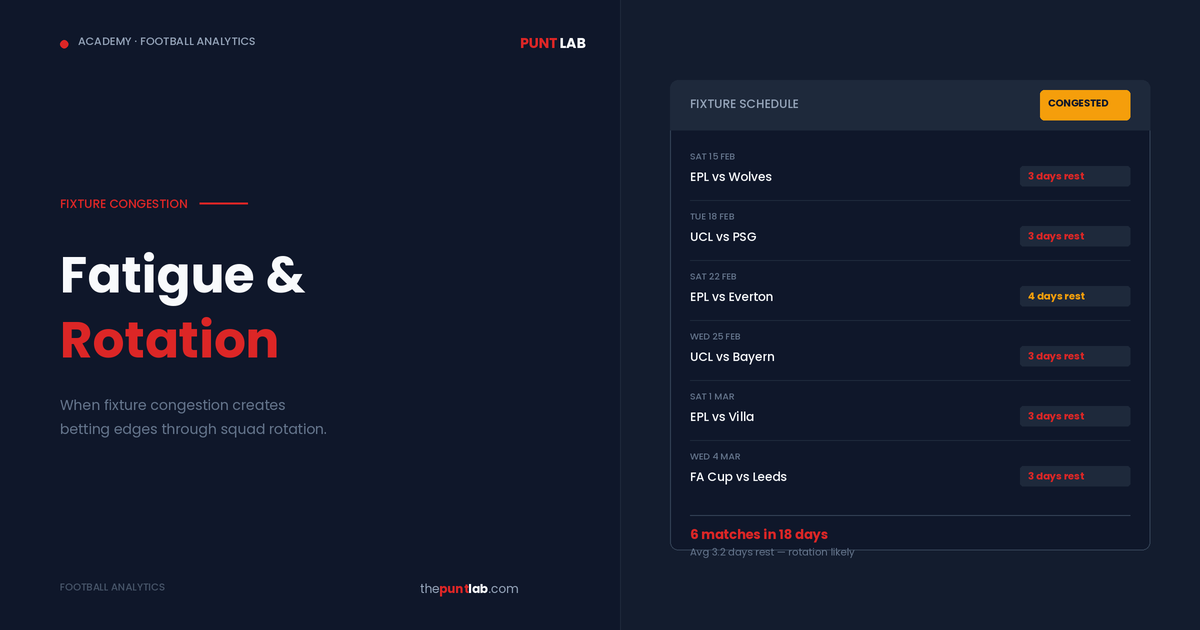
Between September and May, the teams competing across multiple competitions — league, Champions League, FA Cup, League Cup — face stretches where they play every three days for weeks at a time. The physical toll is real, the squad rotation is predictable, and the betting market doesn’t always adjust quickly enough.
Fixture congestion is one of the most actionable edges in football betting because it’s visible days in advance. You can see the schedule before the bookmaker has set the odds. And when a team is about to play its third match in eight days, the probability that they field their strongest eleven drops significantly — which changes everything.
What Fixture Congestion Does to Performance
Physical Fatigue Is Measurable
Research across multiple sports science studies shows that players who play with fewer than four days’ rest show measurable declines in sprint speed, distance covered, and high-intensity running. In football specifically, total distance covered drops by roughly 2-4% and sprint distance drops by 5-8% when a team has less than 72 hours between matches.
That sounds marginal. It’s not. At the elite level, small physical declines translate directly into tactical outcomes: slower pressing, more space conceded in transition, and fewer high-intensity attacking runs. These are exactly the factors that drive xG conceded and goals against.
Mental Fatigue Compounds the Physical
Concentration, decision-making speed, and positional discipline all deteriorate with accumulated match load. Players in a congested stretch make more errors — misplaced passes, poor positioning on set pieces, delayed reactions in defensive transitions. These aren’t random mistakes; they’re the predictable consequence of cognitive fatigue.
The effect is strongest in the second half of matches. Teams in congested schedules concede a disproportionate number of goals after the 70th minute compared to well-rested sides. If you’re betting on BTTS or Over 2.5 goals, late fatigue is your friend.
Squad Rotation: The Predictable Response
Every top manager rotates during congested periods. The question isn’t whether they’ll rotate — it’s how much, and in which matches.
The Priority Hierarchy
Managers prioritise competitions. In general, the Champions League knockout rounds and the domestic league take priority over cup competitions. This means the team you see in a midweek League Cup match is often significantly weaker than the team that plays the weekend league fixture.
For punters, this hierarchy is the edge. If a team plays a Champions League quarter-final on Tuesday and a league match on Saturday, the Saturday lineup will typically be closer to full strength — but the players who started Tuesday will still carry fatigue. Conversely, if the league match is on Wednesday and the Champions League on the following Tuesday, the manager may rest key players on Wednesday to protect them for Tuesday.
Quantifying the Impact of Rotation
When a team makes 5+ changes to their starting eleven, their performance drops significantly. Studies of Premier League rotation across multiple seasons show that teams making heavy changes see their expected points per match drop by roughly 0.3-0.5 points — equivalent to a meaningful shift in win probability.
The market often adjusts for the headline — “Manager rests key players” — but frequently underestimates the cumulative effect. It’s not just about which players are missing; it’s about the disruption to partnerships, communication, and tactical familiarity that comes from a heavily rotated side.
Where the Betting Edge Appears
1. Back the Opponent of a Rotated Side
When a team makes heavy rotation for a cup match, the opponent — even if they’re a lower-ranked side — often offers value. The market adjusts somewhat, but the magnitude of the rotation effect is frequently underpriced. A full-strength mid-table team against a rotated top-four side is a much more competitive match than the brand reputation suggests.
2. Goals Markets in Congested Midweek Fixtures
Matches played midweek during congested periods tend to produce slightly more goals than the equivalent fixture at the weekend. The combination of fatigue-induced defensive errors, slower pressing, and more open play creates conditions that favour goals. If two teams in congested schedules meet midweek, Over 2.5 and BTTS can offer value.
3. The Third Match in a Week
The performance decline is most pronounced when a team plays its third match in 7-8 days. The first and second matches show modest effects; the third shows the steepest decline. If you can identify a team playing its third match in a week — especially away from home — the market often hasn’t fully priced in the accumulated fatigue.
4. Post-European Away Trips
Teams that travel away in European competition on Tuesday or Wednesday and play a domestic match on Saturday show a measurable drop in performance. The effect is strongest when the European trip involved significant travel distance (Eastern Europe, Turkey, etc.) and a late return. The short recovery window plus travel fatigue creates a compounding disadvantage.
How to Identify Congested Fixtures
Step 1: Check both teams’ recent and upcoming fixture schedules. Look for teams playing 3+ matches in 8 days or fewer.
Step 2: Identify the priority match. Is there a Champions League knockout game before or after the league fixture? A cup semi-final? The lower-priority match is where rotation and fatigue are most likely to affect the result.
Step 3: Wait for team news. Lineup announcements (typically 1 hour before kick-off) confirm the extent of rotation. If you see 5+ changes, the match dynamic shifts significantly. If you can’t bet pre-lineup, at least check whether the team news aligns with or contradicts the market’s pricing.
Step 4: Cross-reference with the match preview and Data Hub. Check the team’s recent form, home/away splits on the relevant league page, and whether the underlying data supports the congestion angle.
When Congestion Doesn’t Matter
Not every congested schedule creates an edge. Be careful in these scenarios:
Deep squads with genuine quality depth. Manchester City, Real Madrid, and Bayern Munich can rotate heavily without a dramatic quality drop because their bench players are still elite. The performance decline from rotation is smaller for these clubs than for a team whose B-team is significantly weaker.
Already-priced situations. When rotation is widely expected and heavily covered in the media, the market will have already adjusted. The edge exists when the adjustment is insufficient — not when you’re the only person who noticed the team has a game on Tuesday.
Injury-forced changes vs tactical rotation. There’s a difference between a manager choosing to rest players (tactical rotation) and being forced to change the lineup due to injuries. Injury-forced changes are usually priced in because they’re known days in advance. Tactical rotation often isn’t confirmed until the lineup is released.
The Bottom Line
Fixture congestion is one of the most transparent edges in football betting. The schedule is public, the physical effects are well-documented, and the rotation patterns are predictable. The market knows about it — but it doesn’t always price it correctly, especially in cup competitions, midweek fixtures, and post-European travel scenarios.
Check the schedule. Identify the priority match. Wait for the lineup. Then assess whether the odds reflect the reality of what’s about to walk onto the pitch.
Related Reading
- Over/Under 2.5 Goals — How fatigue affects goal totals
- What Is BTTS? — Late goals from tired defences
- Expected Goals (xG) Strategy — How rotation affects chance quality
- Market Percentages (The Vig) — Stripping margin to assess true value
- Cognitive Biases — Avoid anchoring to team reputation when they’re rotated
Tools
- Odds Converter — Convert odds to implied probability
- Vig Remover — Find the true market probability
- Free Betting Tracker — Track congestion-based bets as a separate strategy