If you only learn one concept from this entire Academy, make it this one. Expected Value — EV — is the mathematical foundation of every profitable betting strategy ever devised. It’s how professional punters evaluate bets, how bookmakers price markets, and how you determine whether a bet is worth placing regardless of whether it wins or loses.
Most punters think in terms of “will this bet win?” That’s the wrong question. The right question is: “If I made this exact bet a thousand times, would I make money?” That’s what EV tells you.
What Expected Value Means
Expected Value is the average amount you expect to win or lose per bet if you placed the same bet an infinite number of times. A positive EV (+EV) bet makes money over time. A negative EV (−EV) bet loses money over time. It’s that simple — and that powerful.
Every single bet you place has an EV. The bookmaker’s entire business model is built on ensuring that, on average, the bets they offer are −EV for the punter and +EV for themselves. The vig — the margin built into every price — is the mechanism that achieves this.
Your job as a bettor is to find the exceptions: bets where your estimated probability of winning is high enough to overcome the margin and produce positive expected value.
The EV Formula
The formula is straightforward:
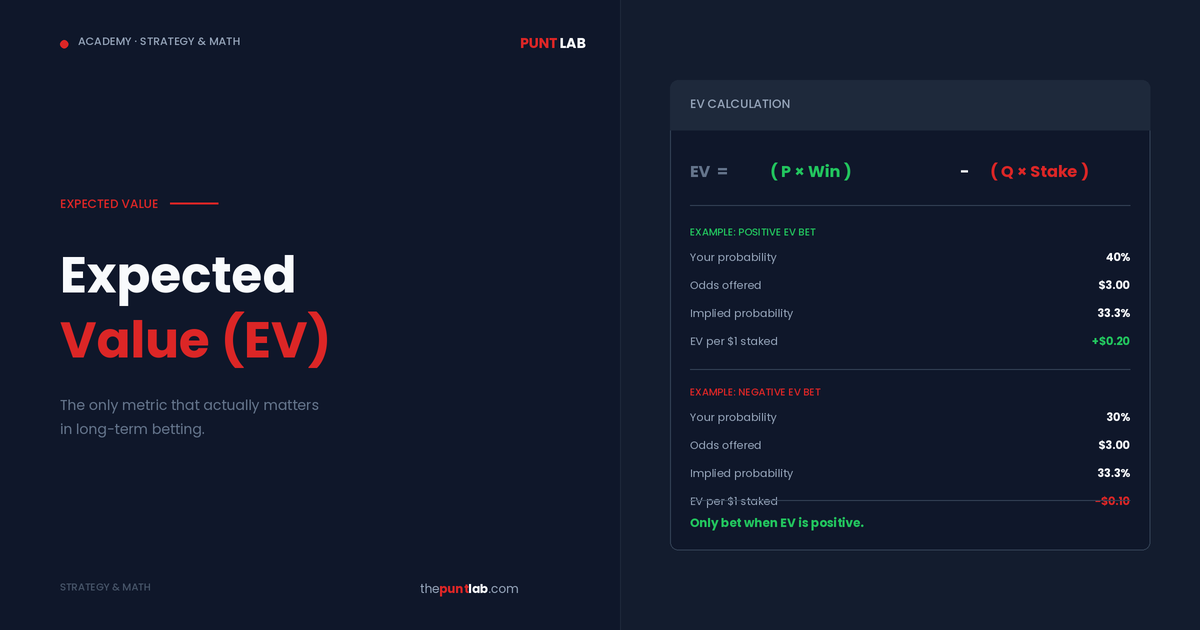
EV = (Probability of Winning × Net Profit) − (Probability of Losing × Stake)
Or expressed per $1 staked using decimal odds:
EV = (P × (Odds − 1)) − (1 − P)
Where P is your estimated probability of winning (as a decimal) and Odds is the decimal price offered.
Let’s work through it.
Example 1: Positive EV
You estimate a team has a 40% chance of winning. The bookmaker offers odds of $3.00.
EV = (0.40 × (3.00 − 1)) − (1 − 0.40)
EV = (0.40 × 2.00) − 0.60
EV = 0.80 − 0.60
EV = +$0.20 per $1 staked
This means that for every $1 you bet in this situation, you’d expect to profit 20 cents on average over time. On a $100 bet, the expected profit is $20. The bet will still lose 60% of the time — but when it wins, it wins enough to more than compensate for the losses.
Example 2: Negative EV
Same odds ($3.00), but now you estimate the team’s true chance at 30%.
EV = (0.30 × 2.00) − 0.70
EV = 0.60 − 0.70
EV = −$0.10 per $1 staked
You’d lose 10 cents per dollar on average. Over 100 bets at $100 each, you’d expect to lose $1,000. The bet might win occasionally — 30% of the time, in fact — but the wins don’t compensate for the accumulated losses.
Example 3: Break-Even
The odds are $3.00, and you estimate the true probability at exactly 33.3% (which is what $3.00 implies in a zero-margin market).
EV = (0.333 × 2.00) − 0.667
EV = 0.667 − 0.667
EV = $0.00
Exactly break-even. You’d neither win nor lose over time. In practice, this is still a losing bet because the bookmaker’s margin means the true implied probability is slightly higher than 33.3% — so you need your estimate to be even further above the implied probability to have genuine +EV.
Why EV Matters More Than Win Rate
This is the concept that separates professionals from everyone else. Most punters judge themselves by win rate — “I won 6 out of 10 bets this week.” But win rate without context is meaningless.
Consider two punters:
Punter A: Backs heavy favourites at $1.30 average odds. Wins 72% of bets. Sounds impressive — but the maths tells a different story. At $1.30 odds and 72% win rate: EV = (0.72 × 0.30) − 0.28 = 0.216 − 0.28 = −$0.064 per dollar. Punter A is losing money despite a 72% strike rate.
Punter B: Backs value longshots at $5.00 average odds. Wins only 23% of bets. Sounds terrible — but: EV = (0.23 × 4.00) − 0.77 = 0.92 − 0.77 = +$0.15 per dollar. Punter B is making 15 cents on every dollar despite winning less than 1 in 4 bets.
Punter A has the better record on paper. Punter B is the profitable bettor. This is why EV is the only metric that actually matters. Win rate, streak length, biggest win — none of these tell you whether your betting is profitable. Only EV does.
How to Find +EV Bets
Finding positive expected value requires two things: an accurate probability estimate and a price that’s higher than it should be. Here’s the practical framework:
Step 1: Estimate the True Probability
Before looking at the odds, assess the probability of each outcome using data. For football, this means checking form, xG data, injuries, home/away splits, and head-to-head records. For racing, it means reviewing the form guide, sectional times, speed maps, and track conditions.
Your estimate doesn’t need to be perfect. It needs to be more accurate than the market’s estimate — even by a few percentage points — for the bet to have positive EV.
Step 2: Convert the Odds to Implied Probability
Use the formula: Implied Probability = 1 ÷ Decimal Odds
Or use the Odds Converter calculator to do it instantly. If the odds are $2.50, the implied probability is 40%. If they’re $4.00, it’s 25%.
But remember — the raw implied probability includes the bookmaker’s margin. Strip the vig using the Vig Remover to see the true market probability. In a 105% market, a team at $2.50 (raw 40%) might have a true market-implied probability of around 38.1%.
Step 3: Compare
If your estimated probability is higher than the true market probability, the bet has positive expected value.
Your estimate: 44%. True market probability: 38.1%. That’s a 5.9 percentage point edge — a strong +EV bet.
Your estimate: 39%. True market probability: 38.1%. That’s only a 0.9 percentage point difference — not enough to be confident there’s genuine value. Pass.
The threshold for acting varies, but most professional bettors look for at least a 2-3 percentage point edge before committing money. Anything less is too close to the margin of estimation error.
The Relationship Between EV and the Vig
The vig is the primary obstacle between you and positive EV. In a zero-margin market, you only need to be more accurate than the market to find +EV. In a real market with a 5% margin, you need to be more accurate than the market plus overcome the margin.
This is why market selection matters. A bet with a 3% edge in a market with a 3% vig has zero EV — the margin eats your edge entirely. The same 3% edge in a market with a 10% vig is deeply −EV. And that same 3% edge on an exchange with a 2% commission is solidly +EV.
Professional bettors understand this intuitively: they gravitate toward low-margin bookmakers and exchange platforms because the lower the margin, the smaller the edge you need to be profitable. Betting into high-margin markets (player props, exotic multis, novelty markets) requires proportionally larger edges — which are harder to find.
EV and Sample Size: The Patience Problem
Here’s the uncomfortable truth about EV betting: positive expected value doesn’t guarantee profit in the short term. It guarantees profit in the long term — over hundreds or thousands of bets — but any individual bet or even any individual month can be negative.
A bet with +10% EV will still lose most of the time if the odds are $5.00. You’ll lose roughly 4 out of 5 bets. There will be losing streaks of 10, 15, even 20 bets. During those streaks, every instinct will tell you the process is broken.
It’s not. The maths is working exactly as expected. Variance — the natural fluctuation of results around the expected value — is brutally noisy over small samples and beautifully predictable over large ones. The professional punter’s discipline is trusting the process through the losing streaks, because they know the EV will converge to profit over time.
This is where tracking your bets becomes essential. If you can see that your Closing Line Value is consistently positive — that you’re beating the market’s final assessment — you know the process is working even during a drawdown. Our free betting tracker is built for exactly this purpose.
EV in Different Markets
Match Result (1X2)
The most liquid football market. Margins are typically 3-5% at competitive bookmakers. Finding +EV requires accurate probability assessment using xG, form, and contextual factors. The efficiency of this market means edges are small (2-5%) but persistent if your model is sound.
Over/Under Goals
Goals markets are well-modelled by bookmakers using Poisson distributions and xG data. Edges tend to appear when contextual factors — fixture congestion, specific tactical matchups, referee tendencies — are underweighted by the pricing model.
BTTS
Both Teams to Score is slightly less efficiently priced than match result. Edges often emerge from defensive data (clean sheet rates, xG Against) that the market underweights relative to attacking data.
Asian Handicaps
Asian lines typically carry the tightest margins in football (2-4%). The efficiency makes +EV harder to find, but the low vig means even small edges are profitable.
Racing Win Markets
Australian racing markets carry higher margins (10-15%) but also greater pricing inefficiency, particularly in large fields and lower-grade races. Genuine +EV bets exist more frequently in racing than in football — but the higher margin means the edge needs to be proportionally larger.
Multis and Parlays
The compounding margin on multi-bets makes sustained +EV extremely difficult. Each leg carries its own vig, and those margins multiply rather than add. A four-leg parlay in a 5% margin market carries roughly 21.6% total margin. Unless every single leg has substantial independent +EV, the multi is −EV by default. This is why professionals overwhelmingly bet singles.
Common EV Mistakes
Confusing High Odds with High EV
A horse at $51 isn’t automatically +EV just because the potential payout is large. If its true probability is 1.5% and the price implies 2%, the bet is actually −EV. High odds are only valuable if they’re higher than the true probability justifies — which is a separate question from how big the payout is.
Ignoring the Vig in Your Calculation
If you estimate a team at 50% and the odds are $2.00 (implied 50%), you might think it’s a fair bet. But the market has a margin — the true implied probability is probably 47-48% after stripping the vig. You’re actually laying $2.00 on a bet where fair odds would be $2.08-$2.13. That’s −EV.
Always strip the vig before comparing your estimate to the market. The Vig Remover does this in seconds.
Outcome Bias
A +EV bet that loses is still a good bet. A −EV bet that wins is still a bad bet. Judging EV by individual results is the fastest way to destroy your process. This is one of the most damaging cognitive biases in betting — evaluating decision quality by outcome rather than process.
Overestimating Your Edge
The most common source of −EV betting is overconfidence in your probability estimate. If you consistently estimate teams at 5% higher probability than their true chance, every bet feels like +EV but is actually −EV. Humility about your estimation accuracy — and a requirement for a meaningful edge before betting — protects against this.
The Bottom Line
Expected Value is the single number that determines whether betting makes you money or costs you money over time. Every other concept in this Academy — odds, vig, xG, biases, bankroll management — exists to help you find and exploit positive EV.
The formula is simple. The discipline to apply it consistently is not. You’ll need to pass on bets that feel good but aren’t +EV. You’ll need to sit through losing streaks knowing the maths is on your side. You’ll need to track everything and trust the process over the results.
That’s the price of profitable betting. EV is how you know it’s worth paying.
Related Reading
- Understanding Betting Odds — Convert odds to implied probability
- Market Percentages (The Vig) — The margin that stands between you and +EV
- Expected Goals (xG) Strategy — Build better probability estimates with data
- Cognitive Biases — The mental traps that corrupt your EV assessment
- The Professional Workflow — How to apply EV in a structured betting process
- Asian Handicap Explained — Low-margin markets where small edges survive
Tools
- Odds Converter — Convert odds to implied probability instantly
- Vig Remover — Strip the margin to find the true market probability
- Kelly Criterion Calculator — Optimal staking once you’ve found +EV
- Free Betting Tracker — Track EV, CLV, and long-term performance