Most punters bet football like it’s a highlights reel.
They look at the scoreline, the ladder, and the last five results and assume it tells the truth. But football is the worst sport to bet that way because it’s low scoring. One goal can decide a match. One deflection, one soft penalty, one keeper howler — and suddenly the “better team” loses.
That’s why serious bettors live in the world underneath the scoreline. And the best entry point into that world is Expected Goals (xG).
TL;DR rule: If a team keeps winning while consistently losing xG, they’re usually overpriced next week.
The scoreboard lies more than you think
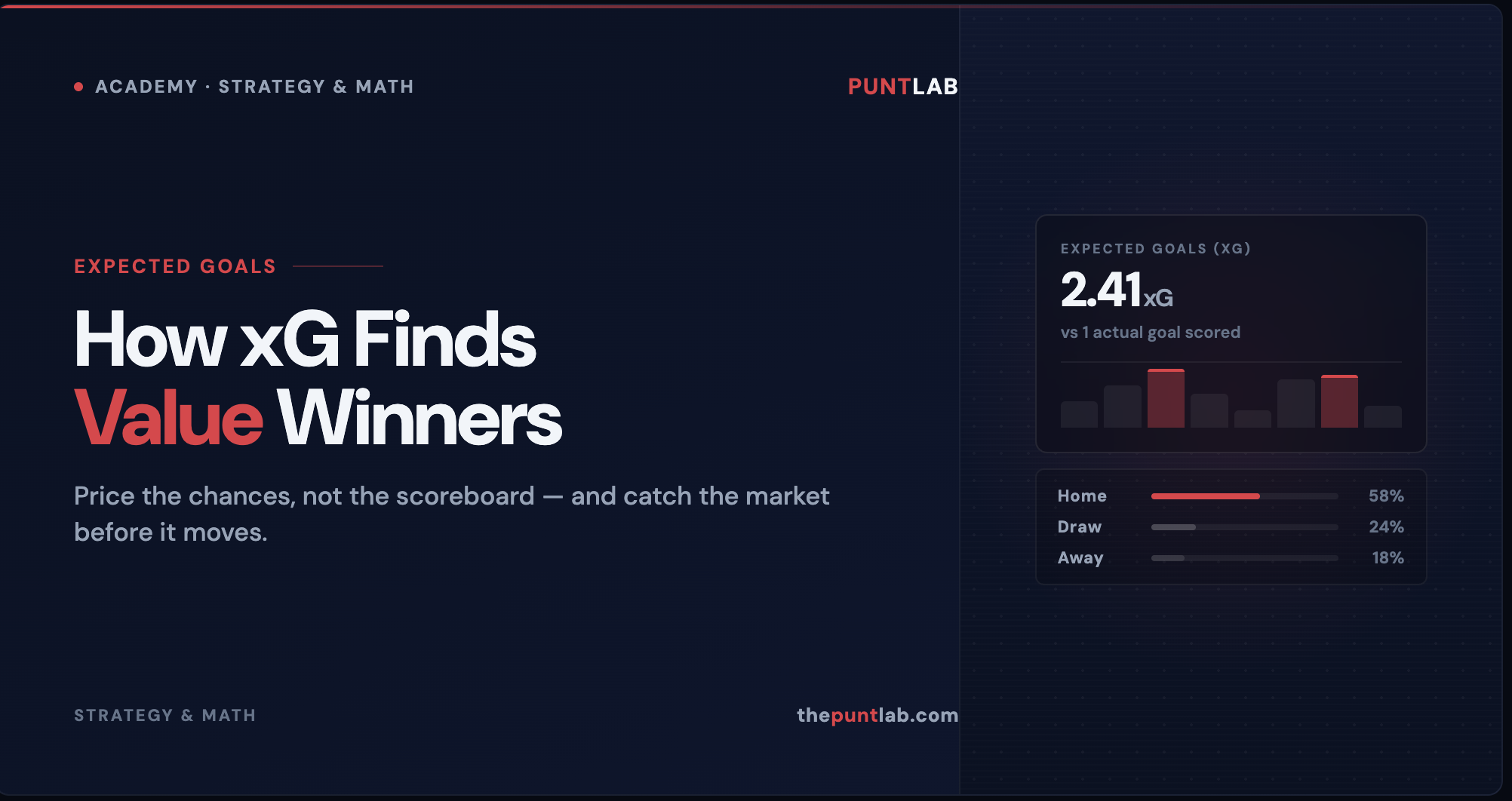
Let’s keep it simple. xG is just a way of measuring chance quality. A tap-in from two metres should go in most of the time, so it’s high xG. A 30-metre hit-and-hope is low xG. Add up all the chances and you get a rough map of what should have happened.
Here’s the backbone of a profitable Expected Goals betting strategy: the market prices teams as if the scoreboard is pure truth. It isn’t. Over a season, xG is one of the cleanest ways to separate real form from fake form.
Think about the kind of win that makes pundits lose their minds. The gritty 1–0 away win. The “champions find a way” narrative. The problem is that those wins often aren’t champion behaviour — they’re variance wearing a designer suit.
A team can win 1–0 with one shot and 0.2 xG. That means they created almost nothing. If they do it twice, the public calls it “clinical”. If they do it three times, the market starts shaving their price shorter because everyone wants to back the “in-form” side.
But what you’re really looking at is a team surviving on luck, finishing benders, and friendly game states. That doesn’t last forever.
The easiest fade spot in football
This is where xG makes you money: it shows you the “fake favourite” before the market catches up.
You’re looking for a team with:
- Results: W-W-W (so the price gets shorter)
- Process: low xG for, high xG against (so the performances are shaky)
When those two collide, you get a favourite priced like a certainty… that’s actually living match-to-match.
The key point: you don’t have to predict the exact upset. You just need to be on the right side of the price. The market overreacts to wins, especially wins by big-name clubs, because casual money follows results. xG lets you bet against that reflex.
A sharp way to read it is:
- If a team wins but loses the xG battle badly, it’s a warning sign.
- If it happens repeatedly, it’s not “clinical”. It’s unstable.
- When they face a competent opponent, that inflated price becomes a target.
One more subtle tell: look at how they’re getting their goals. If they’re scoring from low xG shots or set-piece variance while conceding big chances, the correction usually comes hard and fast. That’s when you’ll see the drift that “came out of nowhere”. It didn’t. The scoreboard just hid it.
Where xG actually finds value
Now flip it around — this is where value winners live.
Some teams lose 1–0 after creating the better chances. They miss two big chances, hit the post, the keeper has a blinder, then they concede from a set piece. The media calls it a “poor performance”. The table calls it another loss. The public ignores them.
But xG tells you they played well. Over time, teams that consistently create good chances and concede little tend to regress upward. Their results improve. The market usually reacts late — and that delay is where you get paid.
Two practical ways to use it immediately:
1) Spot the overvalued favourite.
If they’re winning games while generating low xG and allowing big chances, they’re a candidate to drift — even if the pundits love them.
2) Spot the undervalued loser.
If a team’s recent results are ugly but their xG is solid (creating more than they concede), the market often gives you a better price than it should. That’s where you start finding value winners and value “double chance” angles.
One important warning: don’t use xG like a religion. Use it like a lie detector.
Sometimes a team will “win xG” because they took a pile of low-quality shots late while chasing the game. That’s not the same as being the better side. The cleanest reads come when you add context: game state, red cards, and whether the chances were genuinely high quality.
But even with that limitation, xG is still a huge upgrade from betting the scoreboard. Because the scoreboard tells you what happened once. xG tells you what is likely to keep happening.
Check the latest Premier League xG stats in our Data Hub — that’s where the value winners usually reveal themselves before the price moves. If you want to express your xG reads more precisely, learn how Asian Handicap lets you shape bets around margins instead of just picking winners.