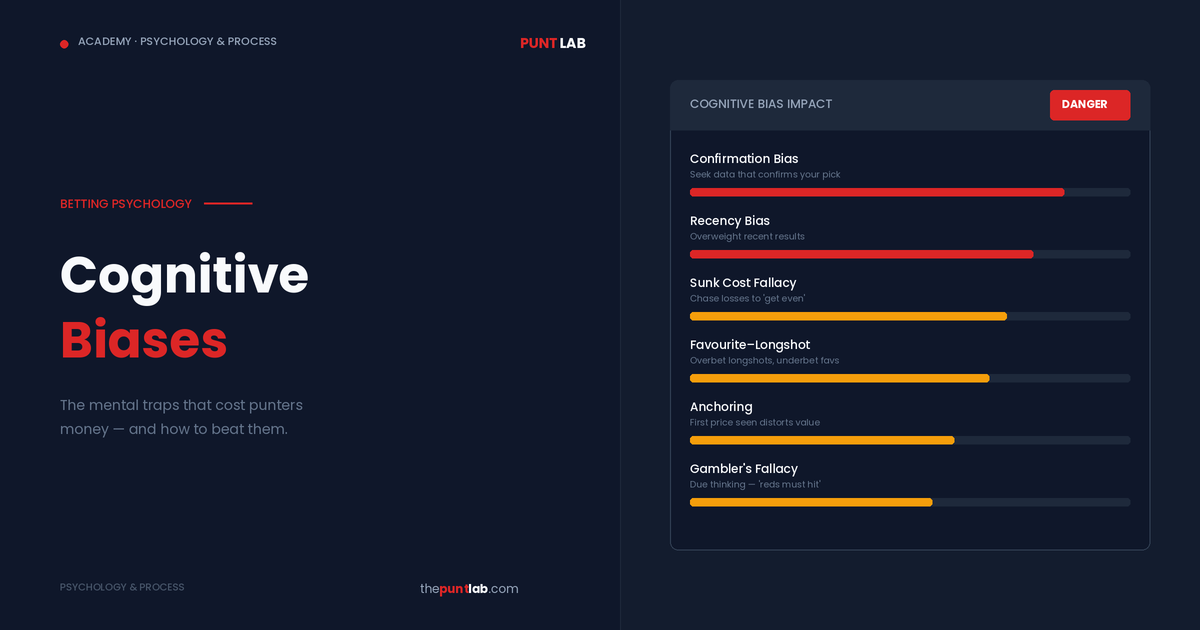
Every punter has a system. They study form, compare odds, check the data. But the biggest threat to your betting isn’t bad data or poor analysis — it’s what your brain does with the information before you click the button.
Cognitive biases are mental shortcuts that evolved to help humans make fast decisions. In everyday life, they’re mostly harmless. In betting, they’re devastating. They distort how you assess probability, how you interpret results, and how you manage your money. And the worst part? You don’t notice them happening.
This guide covers the biases that cost punters the most money — and what to do about each one.
1. Confirmation Bias
What it is: Seeking out information that supports what you already believe, while ignoring or downplaying information that contradicts it.
How it costs you: You’ve decided Manchester City will beat Wolves. So you look at City’s recent form (strong), their xG numbers (impressive), and the head-to-head record (dominant). All true. But you skip over the fact that Wolves have kept clean sheets in 4 of their last 6 home games, that City are missing two key midfielders, and that Wolves’ defensive xG Against has been among the best in the league since Christmas.
You didn’t do bad research. You did selective research. The conclusion came first; the evidence was curated to fit.
The fix: Before placing any bet, actively argue the other side. If you want to back Over 2.5, spend two minutes building the case for Under. If you can’t find a strong counter-argument, the bet might genuinely be good. If you can, you’ve just saved yourself money. This practice — sometimes called “red-teaming” your own analysis — is one of the most effective debiasing techniques available.
2. Recency Bias
What it is: Giving disproportionate weight to recent events over longer-term data.
How it costs you: A team scores 4 goals in their last match and suddenly everyone thinks they’re an attacking powerhouse. But their season-long xG is 1.2 per match and their Over 2.5 rate is only 42%. One high-scoring game doesn’t change a team’s underlying quality — but it changes how the public perceives them.
The market often overreacts to recent results too, which means the odds on that team’s next match might already reflect the “they’re scoring for fun” narrative. You’re not getting value — you’re paying for a narrative that the data doesn’t support.
The fix: Always check the season-long numbers alongside recent form. Our Data Hub pages for the Premier League, La Liga, Bundesliga, Serie A, and Ligue 1 show both — use the full-season data as the anchor and recent form as the adjustment, not the other way around.
3. The Sunk Cost Fallacy
What it is: Continuing a course of action because of what you’ve already invested, rather than what’s rational going forward.
How it costs you: You’ve lost $200 this week. It’s Sunday evening and there’s one more match. You don’t have a strong opinion on it, but you bet anyway because you want to “get back to even.” The previous losses are irrelevant to whether this bet has positive expected value. But your brain doesn’t process it that way — it processes the $200 loss as something that needs to be recovered, and it will lower your standards to create an opportunity to recover it.
This is how bad weeks become terrible weeks. One marginal bet turns into three, and the discipline that normally protects your bankroll evaporates.
The fix: Track your bets in a structured way — a spreadsheet or our free betting tracker — so you can see your long-term results rather than fixating on today’s P&L. Professional punters evaluate performance over months, not sessions. If you wouldn’t place the bet at the start of a fresh week with a clean slate, don’t place it to chase a loss.
4. The Favourite–Longshot Bias
What it is: Systematically overvaluing longshots and undervaluing favourites.
How it costs you: This one is deeply embedded in betting culture. Longshots are exciting — a $21 winner feels incredible. Favourites at $1.50 feel boring. But the data is unambiguous: across virtually every sport and market studied, the public over-bets longshots relative to their true probability and under-bets favourites.
The result is that bookmaker margins are not distributed evenly across a market. Longshot prices typically carry a much higher vig than favourite prices. You’re paying a premium for the thrill.
This doesn’t mean favourites always win or that longshots are never value. It means the baseline expectation should be that the favourite is more likely to be fairly priced (or even value) than the longshot. You need stronger evidence to justify a longshot bet than a favourite bet, because you’re fighting a structural headwind.
The fix: Convert every price to implied probability before assessing it. A horse at $21 isn’t “a roughie that could run a cheeky race” — it’s a horse the market says has a 4.8% chance. If you genuinely believe the true chance is 8%+, bet it. If you just like the idea of a big payout, pass. The odds converter makes this conversion instant.
5. Anchoring
What it is: Over-relying on the first piece of information you encounter when making a decision.
How it costs you: You see a horse open at $8.00 in the morning markets. By race time, it’s $5.00. Your instinct says “that’s short — it was 8s this morning.” But the morning price was set with less information and less market confidence. The $5.00 price at jump time reflects far more informed betting. The morning price is an anchor that distorts your perception of whether $5.00 is actually value.
This works in reverse too. A team opens at $1.80 and drifts to $2.20. The anchor makes $2.20 feel like value — “it was $1.80 this morning, so $2.20 must be overs.” But the drift might reflect genuine new information (injury news, lineup changes, sharp money on the other side) that makes $2.20 the correct price, not a bargain.
The fix: Form your own probability estimate before looking at the odds. If you’ve assessed a team at a 50% chance (fair price $2.00) and the market offers $2.20, you have potential value — regardless of what the opening price was. Your assessment should be independent of the market, then compared to the market. Not derived from it.
6. Gambler’s Fallacy
What it is: Believing that past random events affect future random events. “Red has come up 5 times in a row, so black is due.”
How it costs you: A team has drawn 0-0 in three consecutive matches. The punter thinks “they’re due for goals” and backs Over 2.5. But each match is an independent event. The previous three draws don’t create any physical force that makes goals more likely in the next match.
Now, there might be legitimate reasons to think the pattern will break — the team was unlucky (high xG, low conversion), or they face a weaker opponent, or a key attacker returns from injury. Those are data-driven reasons. “They’re due” is not a data-driven reason. It’s the gambler’s fallacy dressed up as analysis.
The fix: Ask yourself: “Would I make this bet if I didn’t know the recent results?” If the underlying data supports it independently of the streak, bet it. If the streak is the primary reason, pass.
7. Outcome Bias
What it is: Judging the quality of a decision by its result rather than the quality of the decision-making process.
How it costs you: You back a team at $3.00 that you assessed at a 40% chance. They lose. Was it a bad bet? No — it was a positive EV bet that happened to lose. At 40%, it’s supposed to lose 60% of the time. But your brain files it as “wrong” and you second-guess the process.
Conversely, you back a longshot on a whim at $15.00 and it wins. Your brain files this as “great call” even though the process was garbage. One result has reinforced a bad habit.
Over time, outcome bias erodes discipline. You start abandoning good processes because they produced a losing streak, and reinforcing bad processes because they got lucky. This is how punters with sound analytical frameworks slowly drift into gut-feel betting.
The fix: Track your Closing Line Value (CLV) — whether you beat the closing price — rather than just wins and losses. If you consistently bet at better odds than the closing line, you’re making good decisions regardless of short-term results. A punter with positive CLV and a losing month is in a far better position than a punter with negative CLV and a winning month. The wins will come; the process is what determines long-term profit.
8. Availability Bias
What it is: Overestimating the likelihood of events that are easy to recall — usually because they’re dramatic, recent, or emotionally charged.
How it costs you: Leicester won the Premier League at 5,000/1. Everyone remembers it. So when another underdog has a good run of form, punters overestimate the chance of a repeat because the Leicester story is vivid and available in memory. Meanwhile, they underestimate how common it is for mid-table sides to have a good 10-game run and then regress.
The same bias inflates BTTS and Over bets after high-profile thrilling matches. A 4-3 game gets replayed on every highlight show. The 1-0 grind that happened the same weekend is forgotten. Your brain’s sample is skewed toward the memorable, not the representative.
The fix: Use base rates. Before assessing a specific match, check what percentage of matches in that league go Over 2.5, what the team’s season-long BTTS rate is, and what the historical frequency of the outcome you’re considering actually is. Base rates ground your assessment in data rather than memory.
Why These Biases Are So Hard to Beat
The uncomfortable truth is that knowing about cognitive biases doesn’t automatically protect you from them. Research consistently shows that even people who study biases extensively still fall prey to them — the biases operate below conscious awareness, in the fast, automatic parts of the brain that handle intuition and pattern recognition.
What does help is building systems that force you to slow down and engage the analytical, deliberate parts of your brain. Every fix listed above is essentially a process intervention — a structured step that interrupts the automatic response and forces a conscious evaluation.
This is why tracking your bets matters. This is why converting odds to probabilities matters. This is why having a pre-bet checklist matters. None of these things are complicated. They’re simple friction points that give your rational brain a chance to overrule your instinctive one.
The Bottom Line
You can have the best data, the sharpest model, and access to every statistic on every Data Hub page — and still lose money because your brain misprocesses the information before you act on it.
The biases listed above aren’t character flaws. They’re features of human cognition that evolved for survival, not for beating bookmakers. The punters who profit long-term aren’t the ones who’ve eliminated biases — that’s impossible. They’re the ones who’ve built processes that minimise their impact.
Fix the process. The results follow.
Related Reading
- Expected Value (EV) — The mathematical framework for assessing every bet
- Market Percentages (The Vig) — Understanding the cost built into every price
- Understanding Betting Odds — Convert odds to probability instinctively
- What Is BTTS? — Data-driven approach to Both Teams to Score
- Over/Under 2.5 Goals — Using league data instead of gut feel
Tools
- Free Betting Tracker — Track bets systematically to combat outcome bias
- Odds Converter — Convert every price to probability before betting
- Vig Remover — See the true probability behind the bookmaker’s margin