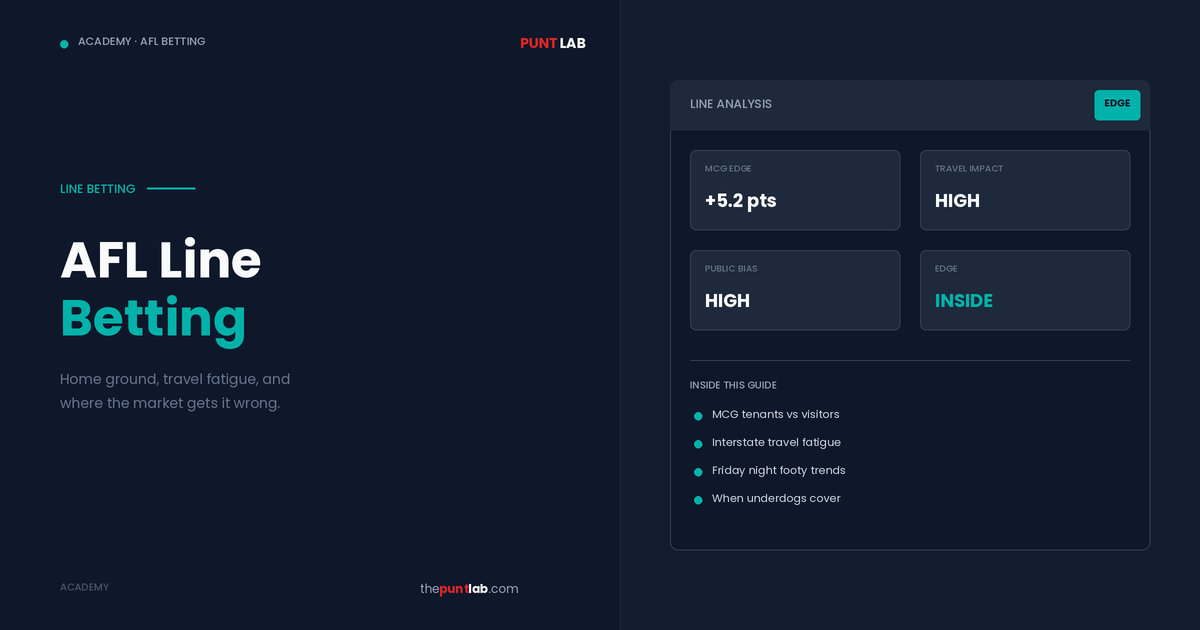
AFL line betting is shaped by two factors that don’t exist to the same degree in any other Australian sport: home ground advantage and travel. The MCG advantage for tenant teams is one of the most documented edges in professional sport. Interstate travel — particularly to Perth and from Perth — creates fatigue effects that show up directly in scoring margins. And yet the market consistently underweights both.
This guide breaks down how AFL lines are set, where the market gets it wrong, and how to build a framework that captures the value.
How AFL Lines Are Set
Bookmakers build AFL lines using team power ratings adjusted for home advantage, recent form, and player availability. The difference between two teams’ ratings, plus a venue adjustment, produces the expected margin. That margin becomes the line.
The venue adjustment is where AFL differs from most sports. It’s not a flat “home team gets +5 points.” It depends on:
Which venue: The MCG produces a larger home advantage than Docklands (Marvel Stadium), which is shared by multiple teams and has a more neutral atmosphere.
Which team is at home: Collingwood’s MCG advantage is different from Melbourne’s MCG advantage because Collingwood draws larger, louder crowds.
Interstate vs intrastate: A Victorian team hosting a Queensland team at the MCG has a larger venue advantage than a Victorian team hosting another Victorian team at the same ground.
Once betting opens, the line moves based on money flow. Public money on popular teams pushes lines wider, and when lines move beyond what the underlying data supports, value appears.
The MCG Advantage
The MCG is the single most significant venue factor in AFL betting. Teams that call the MCG home — Collingwood, Richmond, and Melbourne — play a disproportionate number of their home games on a ground they know intimately.
The advantage comes from multiple sources:
Familiarity: The MCG’s dimensions, surface, and wind patterns are unique. Tenant teams train there, play there regularly, and understand how the ground plays in different conditions. Visitors play there a handful of times per season at most.
Crowd influence: Collingwood and Richmond regularly draw 60,000-80,000+ to MCG home games. The noise, intensity, and one-sided crowd pressure affect opposition decision-making, particularly at critical moments.
Travel compounding: Interstate teams visiting the MCG have already travelled. The MCG advantage sits on top of the travel fatigue — the effects stack.
How to use it: When an MCG tenant hosts an interstate visitor, check whether the line adequately reflects the combined home ground + travel advantage. Historical data shows MCG tenants outperform their overall rating by roughly 5-8 points in this scenario — but the line doesn’t always capture the full effect, particularly early in the season before enough data has been generated.
Interstate Travel
AFL’s national footprint creates travel dynamics that significantly impact results. The key travel corridors and their effects:
Melbourne to Perth (and return)
The longest regular-season trip in AFL. Teams flying to Perth face a 3-4 hour flight, a 2-3 hour time zone change, and a disrupted preparation schedule. The effect is measurable — visiting teams in Perth historically underperform their rating by 3-5 points.
The return trip is also costly. Teams flying back from Perth and playing the following week often show fatigue effects, particularly if they played a physically demanding match.
Melbourne to Brisbane / Gold Coast
Shorter than Perth but still significant. Queensland venues in humid conditions create an additional physical challenge for southern teams, particularly early in the season (February-April) when Melbourne teams haven’t acclimatised.
Melbourne to Adelaide
The smallest interstate travel effect because the flight is short and the time zone difference is minimal. However, Adelaide Oval’s atmosphere — particularly for Showdown matches — creates its own home advantage that benefits Port Adelaide and Adelaide.
Melbourne to Tasmania
An underappreciated travel factor. Tasmanian games (Hawthorn and North Melbourne “home” games in Launceston or Hobart) create a pseudo-neutral venue — neither team has a true home advantage, but the travel to Tasmania disrupts the visiting team more than the nominal “home” team that has played there multiple times.
Friday Night Football
Friday night matches in AFL show a measurable pattern: home teams perform better on Friday nights than on Saturday afternoons. The likely reasons are crowd energy (Friday night atmospheres are more intense), preparation advantage (the home team trains at the venue during the week), and routine (home teams maintain their normal weekly schedule while visitors travel).
How to use it: When a strong home team hosts a weaker visitor on Friday night, the line may not fully reflect the elevated home advantage. Check the team’s specific Friday night record — some teams (Collingwood, Geelong at Kardinia Park) have exceptional Friday night records that exceed even their strong overall home records.
When Underdogs Cover
AFL underdogs cover the line at approximately 48-50% — close to even money. But specific situations produce elevated underdog cover rates:
Wet weather: Rain compresses margins. A team favoured by 30 points in dry conditions might only win by 15 in the wet because scoring drops for both teams but the favourite’s advantage (often skill-based and kicking-dependent) is more affected. See our wet weather AFL guide for the full breakdown.
Rivalry matches: Showdowns (Adelaide vs Port Adelaide), QClashes (Brisbane vs Gold Coast), and Western Derbies (Fremantle vs West Coast) consistently produce tighter results than the H2H odds suggest. Motivation, crowd intensity, and familiarity compress margins.
End-of-season dead rubbers: Teams locked into finals positions with nothing to play for in the last 2-3 rounds of the home-and-away season often rest key players or lack intensity. If the opponent is still playing for a finals spot, the motivation gap can override the talent gap.
Elimination final losers the following season: Teams that lost a finals match the previous season often come out with elevated intensity in the early rounds of the next season — the “unfinished business” effect. If they’re underdogs in these early rounds, they cover at an above-average rate.
When Favourites Cover
Returning from a bye: AFL teams coming off a bye are fresher and better prepared. Favourites returning from byes cover at an elevated rate — the extra preparation time allows coaches to implement specific game plans.
Post-embarrassment bounce-back: Teams that suffered a heavy, public defeat the previous week frequently respond with a dominant performance. The effect is strongest when the heavy defeat came against a team they were expected to beat (the embarrassment factor motivates a response).
Dominant contested teams vs poor contested teams: When a team with elite contested possession numbers faces one that’s weak at the contest, the advantage compounds through the match. The superior contested team controls clearances, creates scoring, and grinds down the opponent. Second-half blowouts are common in these matchups.
A Practical Framework
Step 1: Calculate expected margin using scoring differentials, adjusted for home ground advantage. Use venue-specific data, not generic “home” adjustments.
Step 2: Check for travel. Interstate? Perth or short-haul? Adjust by 3-5 points for long-haul travel, 1-2 for short-haul.
Step 3: Check the weather forecast. If rain is expected, compress the expected margin by 15-25% (a 24-point expected margin becomes 18-20 in the wet).
Step 4: Check for situational factors — rivalry match, bye return, dead rubber, Friday night.
Step 5: Compare your adjusted expected margin to the bookmaker’s line. Strip the vig. If your margin differs from the line by 5+ points, there’s likely positive EV on one side.
The Bottom Line
AFL line betting is shaped by venue and travel more than any other factor. The MCG advantage, interstate travel fatigue, wet weather compression, and Friday night elevation are all measurable, repeatable patterns that the market doesn’t always capture. Build them into your assessment, track your line bets separately with the betting tracker, and let the data compound over time.
Related Reading
- AFL Betting Markets Explained — Every AFL market
- AFL Form Analysis — Stats that predict winners
- Wet Weather AFL — Rain changes everything
- Home Advantage in the Data Age — Football comparison
- Asian Handicap Explained — Football equivalent
- Expected Value (EV) — Only bet with positive EV
- The Professional Workflow — Process over picks
Tools
- Vig Remover — Strip the margin on AFL lines
- Odds Converter — Convert to implied probability
- Kelly Criterion Calculator — Size your stakes correctly
- Free Betting Tracker — Track line bets vs H2H