One of the most common decisions Australian punters face before every race is whether to take the fixed odds price or bet into the tote pool. Most treat it as a coin flip or a gut-feel decision. It’s not. The two systems behave in fundamentally different ways, and understanding those differences can mean the difference between a profitable year and a losing one.
This guide breaks down exactly how each system works, when to use each one, and the specific scenarios where one consistently pays more than the other.
How Fixed Odds Work
Fixed odds are exactly what they sound like — the price is locked in the moment you place your bet. If you take $4.50 on a horse at 10am, you get paid at $4.50 regardless of what happens to the market between then and jump time.
The price is set by the bookmaker’s trading team using a combination of form analysis, market modelling, and their own risk management. The bookmaker builds a margin into every price — the vig — which is how they guarantee a profit regardless of which horse wins.
The key advantage of fixed odds is certainty. You know your return before the race starts. This matters for disciplined punters who calculate expected value before betting — if you’ve assessed a horse at a 25% chance and the fixed price implies 20% (odds of $5.00), you know you have value the moment you click. You don’t need to worry about late money compressing your dividend.
The disadvantage is timing risk. If you bet early and the horse drifts (the price gets longer), you’ve locked in a worse price than what was available closer to jump. Conversely, if the horse firms, you’ve beaten the market — which is actually one of the strongest indicators of a sharp bettor. This concept — beating the closing line — is something we’ll cover in depth in a future Academy guide on Closing Line Value.
How the Tote Works
The tote (totalisator) operates on a completely different model. Every dollar bet goes into a shared pool. The operator takes a commission — typically between 14% and 25% depending on the bet type and state — and the remaining pool is divided among the winning ticket holders proportionally.
This means your final dividend isn’t determined until betting closes (around jump time). If $100,000 is in the Win pool and $15,000 is on the winner, the gross dividend would be $100,000 ÷ $15,000 = $6.67. After the commission is deducted from the pool before the calculation, the actual dividend will be lower.
The critical implication is that tote dividends are driven by public opinion, not by a bookmaker’s assessment of the true probability. If the public over-bets a horse, the tote dividend compresses. If the public ignores a horse, the tote dividend inflates. This creates opportunities that don’t exist in fixed odds markets.
Tote Commission: The Hidden Cost
This is the part most punters don’t properly account for. Tote commission rates in Australia vary by pool type:
Win and Place pools typically carry commissions of 14-16%. Exacta and Quinella pools are higher, usually 18-20%. Trifecta and First 4 pools can reach 25% or more.
Compare this to bookmaker margins on fixed odds, which typically sit between 5-12% on win markets. On face value, the tote is a worse deal — you’re paying a higher margin. But the margin is applied differently. With fixed odds, the margin is baked into every individual price. With the tote, the margin is taken from the pool as a whole, and the resulting dividends can still exceed fixed odds prices on specific outcomes when public money is distributed unevenly.
This is why blanket statements like “fixed odds are always better” are wrong. The tote’s higher commission is a headwind, but the pool dynamics can overcome it in specific scenarios.
When Fixed Odds Pay More
Favourites and Short-Priced Runners
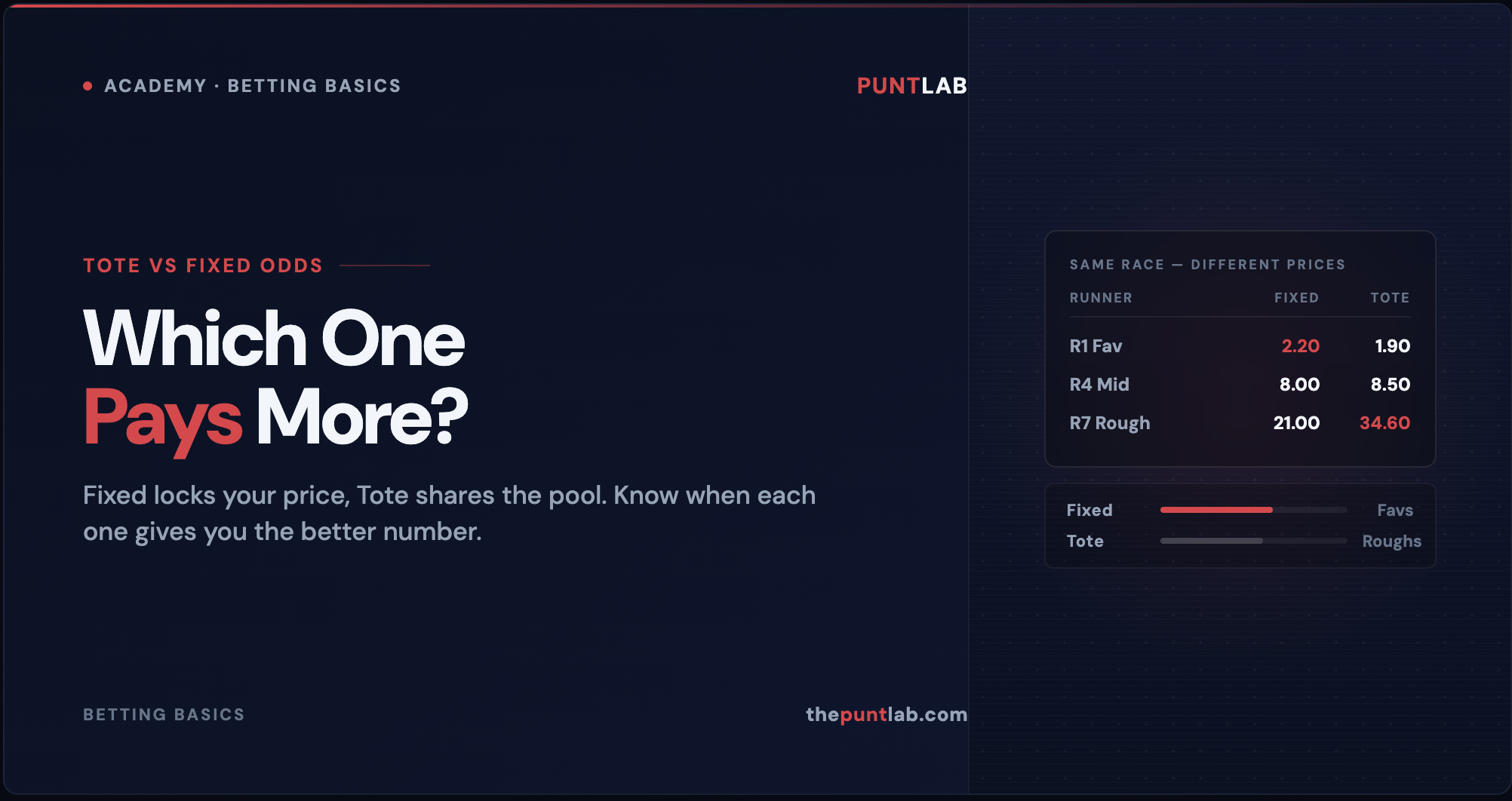
Fixed odds almost always provide better value on favourites. Here’s why: the public loves backing favourites, and on the tote, all that public money goes into the same pool. Heavy favourite backing compresses the tote dividend, often paying significantly less than the fixed price.
A horse at $2.80 fixed might only pay $2.40 on the tote because the pool is saturated with money on that outcome. Over hundreds of bets on short-priced runners, this difference compounds into a major cost. If you consistently bet favourites, fixed odds should be your default.
When You’ve Identified Early Value
If you spot a price that’s likely to shorten — the horse is early value — taking fixed odds locks in the better price. On the tote, late money from others who’ve also spotted the value will compress your dividend. Fixed odds remove that risk entirely.
High-Profile Races with Large Pools
In major races (Melbourne Cup, Cox Plate, Golden Slipper), the tote pools are enormous and public money flows heavily toward the obvious contenders. This means tote dividends on well-backed runners are typically lower than their fixed odds equivalents, while the bookmaker competition for turnover keeps fixed prices sharp.
When the Tote Pays More
Roughies and Outsiders
This is where the tote can genuinely outperform. Bookmakers are cautious with long-priced runners — if they offer $51 and the horse wins, they wear the full payout. So they tend to cap or shorten prices on horses they consider “dangerous” outsiders.
The tote has no such incentive. If the public hasn’t backed a horse, its share of the pool is tiny, and the resulting dividend can be significantly larger than any fixed price available. A horse that’s $31 fixed might pay $45 or $55 on the tote if the public genuinely ignored it.
Small Fields with Uneven Public Betting
In small fields (5-8 runners), public money tends to concentrate heavily on one or two runners. This leaves the rest of the pool relatively untouched. If you’ve identified value in a runner the public has overlooked in a small field, the tote dividend can be substantially better than fixed.
Exotic Bets (Exactas, Trifectas, First 4)
For exotic bet types, the tote is often the only option — most bookmakers don’t offer fixed odds on exotics, or their prices are significantly worse. The tote pool for exotics can produce enormous dividends when the public has overlooked a combination, particularly in larger fields where the number of possible permutations dilutes public money across many outcomes.
Best Tote and Mid Tote: The Middle Ground
Most Australian bookmakers offer “Best Tote” or “Mid Tote” guarantees. These pay you the highest (or middle) dividend across the three Australian tote pools (SuperTAB, NSWTAB, and UniTAB) rather than whichever single tote you bet into.
Best Tote is essentially a free upgrade — you get the best available tote dividend without needing to monitor all three pools yourself. Some bookmakers also offer “Best of Best Tote or SP” (Starting Price), which pays whichever is higher: the Best Tote dividend or the official starting price.
If you prefer tote betting, always use a Best Tote product rather than betting directly into a single tote pool. There’s no reason not to.
A Practical Framework
Rather than guessing each time, use this as your default decision tree:
Bet fixed odds when: the horse is $5.00 or shorter; you’ve identified early value that’s likely to firm; the race is high-profile with large pools and heavy public support on your runner.
Bet the tote when: the horse is $15.00 or longer; the field is small and public money is concentrated elsewhere; you’re placing exotic bets where tote pools are the only real option; you think the bookmaker is being cautious with the fixed price on a roughie.
Compare both when: the horse is in the $6.00-$15.00 range. This is the grey zone where neither system consistently dominates. Check the likely tote dividend against the fixed price and take whichever is better. Best Tote products make this comparison easy.
The Bottom Line
The difference between tote and fixed odds isn’t about which system is “better” — it’s about which system is better for the specific bet you’re making. Favourites and early value plays almost always favour fixed odds. Roughies and overlooked runners in small fields can pay significantly more on the tote. Exotics are tote territory by default.
The punters who consistently make the right choice between the two aren’t guessing. They understand how each system prices risk, where public money distorts dividends, and when the tote’s pool dynamics create opportunities that fixed odds simply can’t match.
Related Reading
- Market Percentages (The Vig) — How bookmakers build their margin into every price
- Understanding Betting Odds — Decimal, fractional, and American formats explained
- Speed Maps Explained — How to predict where every horse will sit in the run
- Sectional Times Explained — Finding hidden merit in the data
- How to Read a Form Guide — The fundamentals of form assessment
Tools
- Odds Converter Calculator — Convert between decimal, fractional, and American odds
- Vig Remover Calculator — Strip the bookmaker’s margin from any odds
- Kelly Criterion Calculator — Optimal staking when you’ve found an edge