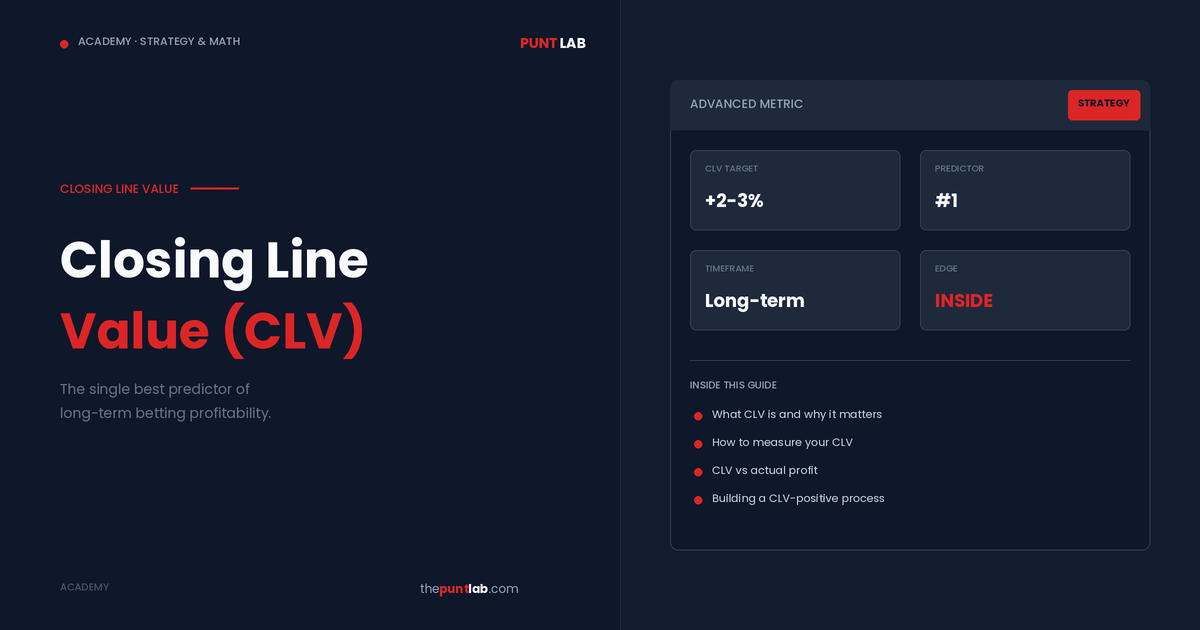
Ask any professional bettor what the single best predictor of long-term profitability is and most will give you the same answer: closing line value. Not win rate, not ROI over a small sample, not how confident you felt about your picks. CLV — whether you consistently beat the closing line — is the metric that separates punters with a genuine edge from those on a lucky run.
This guide explains what CLV is, why it matters more than your results in the short term, and how to measure it.
What Is Closing Line Value?
The closing line is the final set of odds offered by the bookmaker just before an event starts. It represents the market’s most informed assessment of probability because it incorporates all available information — team news, sharp money, public betting patterns, and the bookmaker’s own modelling.
Closing line value means you consistently placed bets at odds that were higher than the closing odds. In other words, you got in before the market moved to the correct price.
Example: You back the Roosters at $2.10 on Monday. By kickoff on Thursday, the line has moved to $1.90. The market decided the Roosters were more likely to win than when you placed your bet. You got +CLV — you got a better price than the closing line.
If you had backed them at $1.80 and the line closed at $1.90, you got -CLV — you paid more than the final market assessment suggested you should have.
Why CLV Matters More Than Results
This is counterintuitive, but it’s mathematically sound: over any sample of fewer than ~1,000 bets, your actual results are significantly influenced by variance. A punter can go 58% over 200 bets through luck alone. Another punter can go 48% over 200 bets despite having a genuine edge.
CLV cuts through the noise. If you’re consistently getting +CLV — even by 2-3% — you’re placing bets at prices the market subsequently decided were too generous. Over thousands of bets, this is the strongest signal that you have a genuine edge.
Professional sportsbooks use CLV to identify sharp bettors. If your account consistently gets +CLV, the bookmaker will restrict your stakes — not because you’re winning, but because your CLV data tells them you will win long-term, even if your current results are flat.
How to Calculate Your CLV
For every bet you place, record two things:
1. Your odds at time of bet — the price you actually received.
2. The closing odds — the final price offered just before the event starts.
CLV formula: CLV% = (Your Odds / Closing Odds – 1) x 100
Example: You bet at $2.10, closing line is $1.90.
CLV% = (2.10 / 1.90 – 1) x 100 = +10.5%
That’s a significant positive CLV — you got 10.5% better odds than the closing market.
Example 2: You bet at $1.85, closing line is $1.90.
CLV% = (1.85 / 1.90 – 1) x 100 = -2.6%
Negative CLV — you paid a premium relative to the closing line.
Track this for every bet. Your average CLV over 100+ bets tells you whether you’re genuinely finding value or getting lucky.
What Good CLV Looks Like
Average CLV of +2-3%: This is the range that professional bettors typically achieve. It doesn’t sound like much, but 2-3% CLV on every bet compounds significantly over hundreds or thousands of bets. This is the mark of a bettor with a systematic, information-based edge.
Average CLV of +5%+: Exceptional. This means you’re consistently getting in well before the market corrects. Either you’re very early on sharp information or you’re operating in less efficient markets where lines move slowly.
Average CLV of 0% or negative: You don’t have an edge, regardless of what your current results say. If your results are positive despite negative CLV, you’re on a lucky streak that will end. Adjust your process.
CLV vs Actual Profit
In the short term, CLV and profit can diverge significantly. You can have +CLV but be in a losing stretch. You can have -CLV but be profitable.
Short-term (under 500 bets): Results are unreliable. CLV is a much better indicator of edge quality. Trust CLV over profit.
Medium-term (500-2,000 bets): Results start to become meaningful but are still noisy. CLV should correlate with results — if you have strong +CLV but negative ROI over 1,000+ bets, something else may be wrong (poor staking, betting into high-vig markets, etc.).
Long-term (2,000+ bets): Results and CLV should align. Persistent +CLV will produce positive ROI given enough bets for variance to even out.
This is why bankroll management is essential — you need to survive the short-term variance long enough for your CLV edge to compound into actual profit.
How to Improve Your CLV
Bet early. Lines are softest when they first open. The longer you wait, the more information gets priced in by sharp bettors. If your analysis identifies value, place the bet as early as possible.
Bet into efficient markets. CLV is most meaningful in liquid, well-modelled markets — NBA spread, NRL line, EPL match result. In thin markets with wide spreads, CLV is noisier and less reliable as an edge indicator.
Form your view before seeing odds. The professional workflow emphasises forming your probability estimate before looking at the bookmaker’s price. This prevents anchoring bias — where seeing the price first distorts your assessment — and produces more independent, edge-generating analysis.
Track and review. Record your CLV for every bet in the betting tracker. Review monthly. If your CLV is consistently negative, your process needs adjustment — either your analysis, your timing, or the markets you’re betting into.
The Bottom Line
CLV is the professional’s metric. It tells you whether you’re beating the market — not whether you’re getting lucky. Track it relentlessly, trust it more than your short-term results, and use it as the primary feedback mechanism for improving your betting process. If you’re consistently getting +CLV, the money will follow. If you’re not, no amount of results-based analysis will save you long-term.
Related Reading
- Bankroll Management — Survive long enough for CLV to compound
- Staking Methods Compared — Size bets to your edge
- Expected Value (EV) — The mathematical foundation
- Market Percentages (The Vig) — What you’re paying the bookmaker
- The Professional Workflow — Form estimates before seeing odds
- Cognitive Biases — Anchoring and outcome bias
Tools
Betting Tracker Record CLV on every bet Vig Remover Strip the margin for true closing probability Odds Converter Convert odds to compare opening vs closing Kelly Calculator Stake based on your CLV-derived edge