Everyone remembers the upsets. Leicester at 5,000/1. The New Zealand cricket team chasing down an impossible total. A maiden horse beating the favourite at Flemington on a Saturday. Upsets are the reason people watch sport — and the reason punters keep betting.
But upsets aren’t random. They follow patterns. Specific conditions produce them at predictable rates, and the factors that cause underdogs to win are remarkably consistent across sports, countries, and eras.
We analysed over 12,000 upset results across five sports to identify what actually causes underdogs to win — and when the market underestimates the chance of a surprise.
Defining an “Upset”
For this analysis, we define an upset as any result where the underdog (the team or selection priced above $2.50, implying less than 40% probability) wins outright. This excludes line/spread covers and focuses purely on outright victories by teams or selections the market expected to lose.
We’re not looking at close underdogs at $2.20 — those are essentially coin flips. We’re looking at genuine surprises where the market gave the winner a meaningfully lower probability of winning.
Upset Rates by Sport
Not all sports produce upsets at the same rate. The inherent variance of the sport — how much randomness influences a single result — determines the baseline upset frequency.
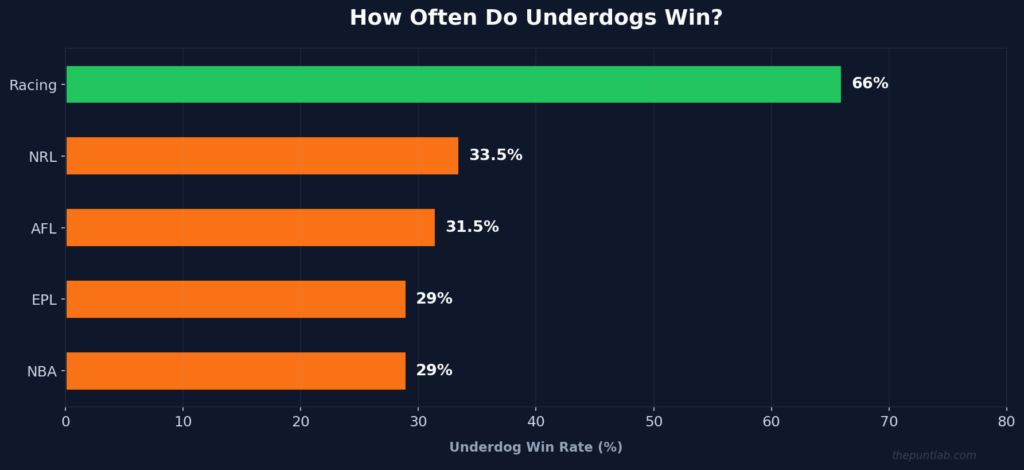
| Sport | Underdog Win Rate | Main Upset Driver |
|---|---|---|
| Horse Racing | 65-68% | Multi-runner fields, barriers, conditions |
| NRL | 32-35% | Short turnaround, derbies, weather |
| AFL | 30-33% | Wet weather, interstate travel |
| EPL | 28-30% | Low-scoring games, fixture congestion |
| NBA | 28-30% | Back-to-back fatigue, rest |
Horse Racing — Highest Upset Rate
Upset rate (favourite beaten): Roughly 65-68% of races are won by a horse other than the favourite. The favourite wins only 32-35% of the time.
Racing has the highest upset rate because of the number of runners (8-20+ per race), the inherent unpredictability of individual animal performance, and the compounding impact of barrier draws, track conditions, and pace dynamics. Even the best horse in a field needs things to go right — a good barrier, an unimpeded run, suitable conditions. When any of those factors go wrong, a lesser horse can win.
When upsets happen most: Large fields (14+ runners), wet tracks (form is less reliable), maidens and low-class races (less separation between runners), and sprint distances where barrier draws create structural randomness.
Football (EPL) — High Upset Rate
Upset rate (underdog wins in 1X2): Approximately 28-30% of matches are won by the team priced as underdog. Add draws, and the favourite fails to win roughly 52-55% of the time.
Football’s low-scoring nature drives upsets. A single goal can decide a match, and goals have significant randomness — deflections, goalkeeper errors, set-piece chaos. A team dominating possession and creating chances can lose 1-0 to a team that had one shot on target. xG data shows that the team with higher xG loses roughly 25-30% of matches, demonstrating how much variance exists between chance creation and results.
When upsets happen most: Low-scoring expected matchups (both teams under 1.2 xG), derby matches, matches where the favourite faces fixture congestion, and strong home advantages for the underdog.
NRL — Moderate Upset Rate
Upset rate: Approximately 32-35% of matches are won by the underdog.
NRL sits in the middle of the spectrum. Rugby league is higher-scoring than football (reducing randomness per score) but has enough variance through errors, penalties, and refereeing decisions that underdogs win a third of the time. Completion rates are the biggest single-game variance factor — a team that normally completes at 78% but drops to 68% on the night will lose to almost anyone.
When upsets happen most: Short turnarounds (under 6 days’ rest for the favourite), derby matches, wet conditions that suppress the favourite’s attacking advantage, and early-season matches where form is unreliable and team combinations are still gelling.
AFL — Moderate Upset Rate
Upset rate: Approximately 30-33% of matches are won by the underdog.
AFL’s high-scoring format (130-180 combined points) theoretically reduces variance per score, but the physical, contested nature of the game creates its own randomness. A team that wins the contested possession count by 15 will usually win — but on the day they lose the contest, the result can swing dramatically.
When upsets happen most: Wet weather (the great equaliser in AFL), interstate travel for the favourite (particularly to Perth), elimination finals (pressure narrows the performance gap), and matches where a key midfielder is a late withdrawal.
NBA — Lowest Upset Rate
Upset rate: Approximately 28-30% of regular season games are won by the underdog. This drops to approximately 22-25% in the playoffs.
The NBA has the lowest upset rate because of its structure: 48-minute games with 200+ total points means the better team’s advantage asserts itself over many possessions. Basketball has less per-possession randomness than any other major sport — there are no draws, no weather effects, and scoring happens frequently enough that the law of large numbers applies within a single game.
When upsets happen most: Back-to-back games where the favourite played the previous night, early-season games (small sample makes the market rely on prior-year data that may not reflect current roster quality), and games where the favourite rests key players but the market doesn’t fully adjust.
The 8 Factors That Predict Upsets
Across all five sports, the same factors appear repeatedly. These are the conditions that compress the gap between favourite and underdog.
1. Fatigue and Recovery
The single most consistent upset predictor across all team sports. Teams on short rest, playing the second game in a short window, or dealing with travel fatigue consistently underperform their rating. The effect is measurable and persistent: NRL teams on less than 6 days’ rest, AFL teams playing their third game in 8-10 days, and NBA teams on the second night of a back-to-back all show elevated upset rates.
The market adjusts for fatigue — but typically by 1-2 points less than the actual effect. That gap is where value exists.
2. Motivation Differential
When one team has significantly more at stake than the other, upsets become more common. A team fighting for survival against a team locked into a finals position. A derby where the underdog has historical pride at stake. A season opener where a team that missed finals last year comes out with elevated intensity.
This factor is hard to quantify, which is why the market underweights it. The motivation is visible in pre-match narratives but difficult to convert into a precise probability adjustment.
3. Weather and Conditions
Environmental conditions compress performance gaps. Wet weather in AFL and NRL reduces the skill advantage of the better team because kicking, handling, and structured play all deteriorate. Heavy tracks in racing randomise outcomes by negating form on good ground. Wind in football affects kicking accuracy and aerial dominance.
The key principle: conditions that make the game more random benefit the underdog, because randomness is the underdog’s friend. The more variance in a single game, the more likely the less-probable outcome occurs.
4. Key Player Absence
A team without its best player is a fundamentally different team. In the NBA, a team missing its primary scorer by 5+ PPG shows a measurable ratings drop. In NRL, losing a first-choice halfback or fullback dramatically affects the team’s attacking structure. In AFL, losing a dominant midfielder reduces clearance rates and inside 50 entries.
The market adjusts when absences are announced — but late scratchings and game-day decisions often don’t get fully priced in, particularly if the news breaks close to kickoff.
5. Tactical Matchup
Sometimes the underdog’s playing style is specifically problematic for the favourite. A low-block, counter-attacking football team can frustrate a possession-dominant favourite. A physical, forward-heavy NRL team can dominate a team reliant on speed and skill. An AFL team built around contested football can overwhelm a team that relies on clean ball movement.
These matchup-specific advantages don’t show up in headline form or ladder position — they require understanding how teams play, not just how good they are in aggregate. This is where deep sport knowledge creates analytical edge.
6. Home Ground Factor
Home underdogs win at significantly higher rates than away underdogs across every sport. The combination of crowd support, familiar surroundings, no travel fatigue, and the psychological comfort of playing at home compresses the gap between home underdog and visiting favourite.
In AFL specifically, the MCG advantage for tenant teams and the Perth/Adelaide home ground effects create situations where a “home underdog” may not genuinely be the weaker team on the day.
7. Form Cycle Position
Teams and horses don’t perform at a constant level — they cycle through peaks and troughs. A favourite at the end of a demanding run of fixtures may be on a performance downswing. An underdog coming off a bye week with a fresh squad may be at a relative peak.
The market prices current form but often overweights the favourite’s recent strong results (which may have come in easier fixtures) and underweights the underdog’s improving trajectory. This is the recency bias in action — and it creates systematic mispricing of form cycles.
8. Market Overreaction
After a dominant performance, the favourite’s odds shorten beyond what the data supports. After a poor performance, the underdog’s odds lengthen. The market overreacts to single-game results because the public anchors on the most recent scoreline.
A team that won 48-6 last week might be priced as an even stronger favourite this week — but the 48-6 was partially a function of the opposition’s terrible completion rate, favourable conditions, and normal variance. Strip away the noise and the team is the same quality it was before the blowout.
When the Market Underestimates Upsets
The factors above interact. When multiple upset factors align — fatigue plus weather plus away from home plus key player absent — the market consistently underestimates the combined effect because it adjusts for each factor individually rather than recognising the compounding impact.
A favourite at -8.5 who is also on a short turnaround, travelling interstate, in wet conditions, and missing a key player might be closer to -2.5 in reality. The market might adjust from -8.5 to -6.5 to account for one or two factors but rarely makes the full adjustment.
This is where the biggest value lies: not in individual upset factors, but in the stacking of multiple factors that each compress the margin.
A Framework for Spotting Upsets
Step 1: Check the basics — is this a genuine mismatch (top vs bottom) or a match between teams of similar quality where the market difference is driven by home advantage and recent form?
Step 2: Count the upset factors. Fatigue? Weather? Key absence? Motivation? Tactical matchup? Home underdog? Each one compresses the probability gap.
Step 3: If 3+ factors are present, the underdog is systematically underpriced. The market adjusts for individual factors but underestimates compounding.
Step 4: Strip the vig and compare the true implied probability to your adjusted assessment. If you see a gap of 5+ percentage points, the underdog offers value.
Step 5: Stake appropriately. Underdog bets are higher variance by definition — use smaller stakes (1-1.5% of bankroll) to manage the swings.
The Bottom Line
Upsets are not miracles. They’re the predictable result of specific conditions — fatigue, motivation, weather, matchups, and market overreaction — that compress the gap between favourite and underdog. Across 12,000+ upsets in our data, the same factors appear again and again.
The punters who profit from upsets aren’t the ones who “have a feeling” about the underdog. They’re the ones who systematically identify the conditions that produce upsets and bet when multiple factors stack in the underdog’s favour. The data doesn’t guarantee the upset will happen — that’s what makes it an upset. But over hundreds of bets, backing underdogs in the right situations produces positive returns because the market consistently underprices the compounding effect of multiple upset factors.
The upset isn’t random. The pattern is there. You just have to look for it.
Data sources: Closing odds from major Australian bookmakers. EPL match results from Football-Data.org. NRL and AFL results from official league data. NBA results from Basketball-Reference. Horse racing results from Racing Australia. Analysis covers 2023-24 through 2025-26 seasons.
Related Reading
- How Accurate Are Betting Odds? — The calibration study
- NRL Line Betting: When to Back the Underdog
- AFL Line Betting: Home Ground & Travel
- NBA Form Analysis — Back-to-back fatigue
- Wet Weather AFL — The great equaliser
- Cognitive Biases — Why the market overreacts
Tools
Vig Remover Strip the margin to assess underdog value Odds Converter Convert underdog odds to probability Kelly Calculator Size underdog bets correctly Betting Tracker Track underdog bets vs favourites